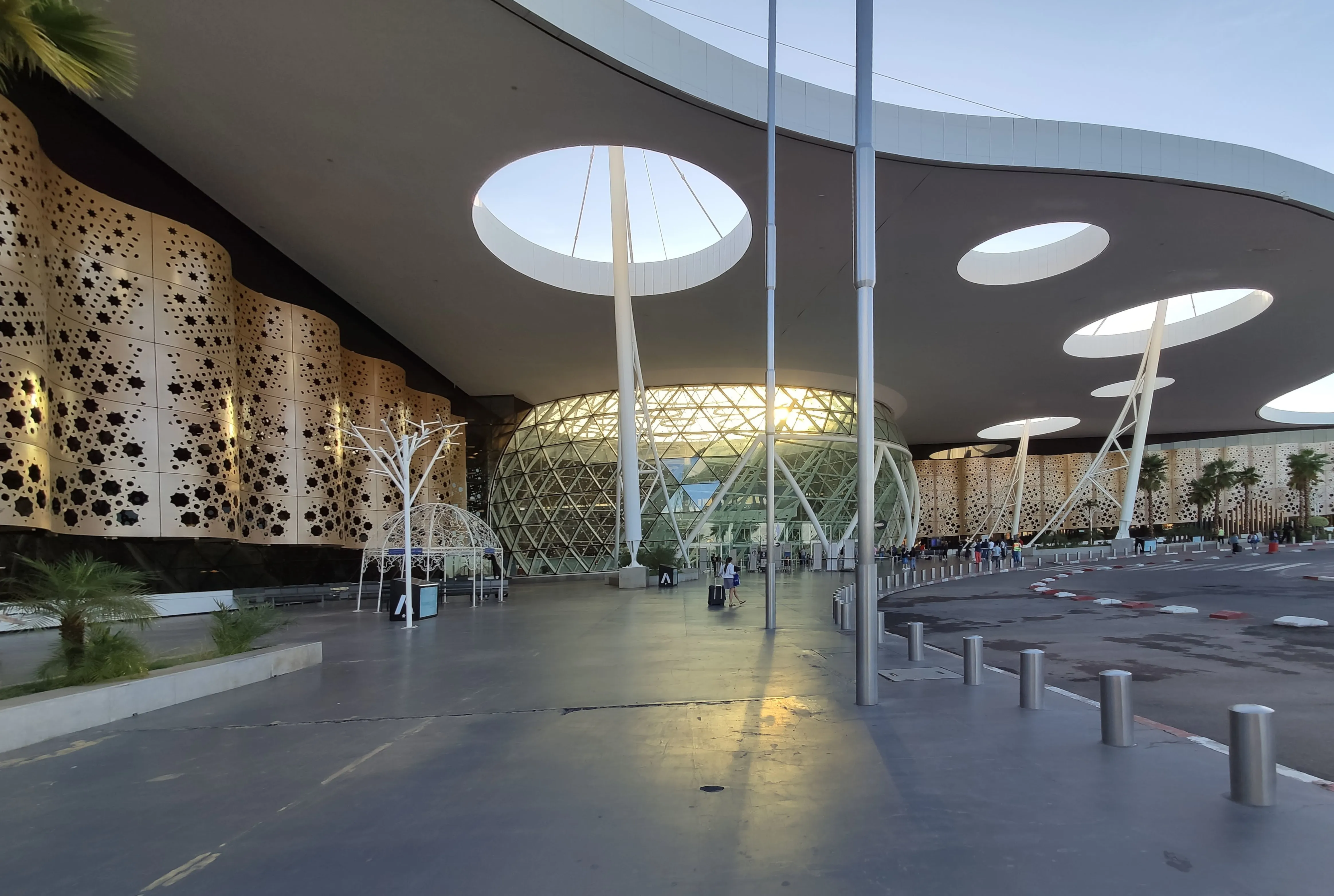
When you fly out of Marrakech Menara Airport (RAK), assume the standard international liquids rule for your cabin bag: every liquid, gel, paste, cream or aerosol must be in a container of 100 ml or less, and all of them must fit in one transparent, resealable bag of about 1 liter, shown separately at security. Anything bigger, including the argan oil, honey and amlou you bought in the souks, belongs in your checked luggage. The main exceptions are essential medicines, baby food and duty-free bought airside in a sealed bag.
Below we cover what counts as a liquid, the two security checks at RAK, how to pack Moroccan souvenirs, duty-free on connecting flights, power banks and vapes, and whether Europe’s new “2-liter” scanner lanes change anything in Marrakech. We are an independent, unofficial guide, not affiliated with ONDA (the national airports office that runs Marrakech Menara) or any airline, and rules can change, so confirm anything critical with your airline.
Marrakech airport liquid rules at a glance
| Item | Cabin bag? | Checked bag? | Note |
|---|---|---|---|
| Toiletries up to 100 ml | Yes, inside the 1-liter clear bag | Yes | One clear bag per passenger |
| Any container over 100 ml, even part-empty | No | Yes | The size printed on the container counts |
| Argan oil bought in town | Only bottles of 100 ml or less | Yes | Double-bag it in the suitcase |
| Honey, amlou, jam, olive oil | Only 100 ml or less | Yes | Pastes and spreads count as liquids |
| Rose water, perfume | Only 100 ml or less | Yes | Larger perfume only if bought airside |
| Spices, tea, dates, dry sweets | Yes | Yes | Solids; dense packs may be hand-checked |
| Duty-free liquids bought airside | Yes, sealed bag + receipt | Not applicable | Can be refused if re-screened on a connection |
| Liquid medicines | Yes, amounts needed for the trip | Yes | Carry prescription; declare at screening |
| Baby milk and baby food | Yes, amounts for the journey | Yes | Declare; may be tested |
| Empty water bottle | Yes | Yes | Fill it after security |
| Power banks, spare lithium batteries | Yes, cabin only | No | Watt-hour limits apply |
| E-cigarettes / vapes | Cabin only, if your airline allows | No | Never use or charge on board |
| Lighter | Usually one, carried on you | No | Check your airline |
| Ceramics, tagines, glass tea sets | Yes, if they fit | Yes, well wrapped | Not liquids, just fragile |
What is the liquid rule at Marrakech airport?
Marrakech applies the same liquids, aerosols and gels rule as most of the world’s airports. Royal Air Maroc, Morocco’s national carrier, states it on its hand-baggage rules page: liquids and gels are “allowed in the cabin only in containers of a maximum of 100 ml each”, grouped in a single transparent, resealable one-liter bag presented separately at security. The European Commission describes the same standard on its liquids, aerosols and gels page.
Details that catch people out:
- Container size, not contents. A 200 ml bottle with a little left in it is still a 200 ml bottle.
- One bag per passenger, around 20 x 20 cm, that closes properly. A bag you have to force shut, or tie at the top, can be refused.
- Take it out. The clear bag goes in a tray on its own.
- It is a screening rule, not an airline rule. Your airline sets the size and weight of your cabin bag; the liquids limit applies at the checkpoint whatever ticket you hold.
The rule dates back to the 2006 transatlantic aircraft plot, a foiled plan to bring liquid explosives disguised as soft drinks onto flights from the UK to North America; limited volumes returned to UK cabins from November 2006 and the 100 ml system spread from there. It is still the default at most airports, including Marrakesh Menara Airport (IATA RAK, ICAO GMMX).
How many security checks are there at Marrakech airport?
Departing passengers go through two separate screenings at RAK.
- The entrance screening at the terminal door. Before you reach the check-in desks, every bag (suitcases included) goes through an X-ray and every person walks through a detector. Friends and family seeing you off go through it too.
- The main cabin-bag screening. After check-in or bag drop, you head toward passport control and the main hand-luggage screening before the airside departure lounge. This is where the liquids rule is enforced: clear bag out, electronics out if asked, jacket and belt in the tray.
The key consequence: once your suitcase has gone down the belt at bag drop, you can no longer move a bottle into it. If a jar of honey turns up in your cabin bag at the main screening, you will usually have to leave it behind. Sort your liquids at your riad or hotel, not at the airport.
For the full sequence on the day, from arrival times to boarding by bus, see our Marrakech airport departures guide. For the layout of the halls and airside zone, see the terminals and facilities overview.
What counts as a liquid? The Moroccan shopping edition
Security staff use a broad definition. The UK government’s liquids guidance lists drinks, semi-liquid foods such as soup, jam, honey and syrups, cosmetics and toiletries, sprays, pastes including toothpaste, gels and contact-lens solution. Applied to what visitors typically carry home from Morocco:
Treated as liquids (100 ml limit in the cabin):
- Oils: argan oil (culinary or cosmetic), olive oil, prickly-pear seed oil.
- Spreads and syrups: honey, amlou (almond, argan and honey spread), jams, date syrup.
- Wet foods: hummus-style dips, tahini, harissa, olives or preserved lemons in brine or oil, soft cheese, yogurt.
- Floral waters and perfume: rose water, orange-blossom water, perfume, liquid musk.
- Cosmetics: creams, lotions, mascara, lip gloss, black soap (savon beldi, a soft paste), henna paste.
- Aerosols and gels: deodorant sprays, sun spray, hand sanitizer, toothpaste.
- Snow globes and other souvenirs with liquid sealed inside.
Generally fine as solids: whole and ground spices, ras el hanout, saffron, dried mint and tea; dates, nuts and dry pastries such as cornes de gazelle; solid soaps, ghassoul clay, solid perfume and lipstick; bread, msemen and packaged snacks.
Powders are not liquids, but dense packs of spices or clay can block the X-ray image and lead to a hand search. Some routes add their own rules: Royal Air Maroc’s page notes that on its Morocco to United States flights, powder-like substances of 350 ml or more must be checked in as hold baggage.
Can you take argan oil, honey and amlou on the plane?
Yes, but where they go depends on size.
- Cabin bag: only in containers of 100 ml or less, inside your clear bag. Small bottles of cosmetic argan oil are common in shops and cooperatives and are the only version bought in town that can travel in hand luggage.
- Checked bag: any reasonable size, packed so it cannot leak (see below).
- Bought airside after security: larger bottles can travel in the cabin, sealed with the receipt. That works well on a direct flight, less well on a connection (see the duty-free section).
Also check your destination’s import rules before buying in bulk. Honey and dairy are animal products, and several countries restrict what travelers can bring in. Rules differ by country, so check your own customs or biosecurity authority’s website.
How to pack your cabin liquids: step by step
- Decide cabin or hold the night before. Anything over 100 ml goes straight into the suitcase you will check.
- Decant into travel bottles of 100 ml or less, labeled.
- Bring a clear, resealable bag of about 1 liter (roughly 20 x 20 cm) from home; do not count on finding one at the airport.
- Fill it so it closes easily. If it only seals when stretched, take something out.
- Keep exemptions separate. Liquid medicines, baby milk and special dietary items go in their own bag with prescriptions or documents.
- Pack the bag on top of your cabin bag, since you will open it at both screenings.
- Empty your water bottle before the main screening.
- Present the liquids bag in its own tray, plus laptops or tablets if staff ask.
- Buy anything larger after security.
How to pack Moroccan souvenirs in checked luggage
Your checked bag has no 100 ml limit, but it gets thrown, stacked and squeezed, and pressure and temperature changes can push oil past a loose cap.
Argan oil and olive oil
- Tighten, tape, bag. Screw the cap tight, tape over the cap seam, seal each bottle in a zip bag, then put that in a second bag.
- Prefer plastic or tins for olive oil. Glass is heavy and breakable.
- Pack in the center of the suitcase, wrapped in clothes, away from the sides and wheels.
- Mind the weight. A liter of oil weighs close to a kilo before the bottle, which matters with tight low-cost allowances.
Amlou, honey and jars
Ask for sealed jars where possible, or add plastic film under the lid. Double-bag every jar, wrap it in clothing, and check that metal lids are tight before packing.
Rose water, orange-blossom water and perfume
Same method as oils: tape, bag, double-bag. Perfume over 100 ml goes in the hold unless you buy it airside.
Spices and tea
Choose sealed, labeled packs rather than loose paper cones from a stall, and keep them in a zip bag so the smell does not spread through your clothes. Small packs can also go in the cabin.
Ceramics, tagines and glass
Wrap each piece in a towel or clothes, stuff hollow pieces such as tagine lids with socks, and pack them in the middle of the case. If a piece fits within your cabin allowance, carrying it on board is the gentlest option; it is not a liquid, so security will not object.
Spending a last day in the medina before an evening flight? Our layover guide covers timing a city visit around the airport.
Duty-free liquids and sealed STEB bags
Liquids bought in the airside shops at RAK can exceed 100 ml in the cabin because they are sold after the main screening. They are sealed in a security tamper-evident bag (STEB) with the receipt visible inside. Leave it sealed until your final destination.
On a direct flight, this works smoothly: nobody screens the bag again before you land.
On a connecting flight where you pass through security again, the bag is screened under the hub’s rules. The European Commission’s liquids page lists the third countries whose duty-free liquids, in a STEB with proof of purchase, are accepted on transfer at EU airports: it names airports in Canada, the United States, Singapore, Malaysia and Croatia, and Morocco is not on it. A sealed 500 ml perfume from RAK can therefore be refused at an EU transfer security check. The UK government’s guidance likewise tells travelers to check the rules at every airport on their journey.
What to do:
- Direct flight home: buy airside freely, keep the STEB sealed and the receipt.
- Connection with a security check: buy liquids in town and check them in, or buy at your connecting airport.
- Not sure? Ask your airline whether you re-clear security at the hub.
For what is on sale airside and how prices compare with the medina, see our Marrakech airport duty-free and shopping guide.
Medicines, baby milk and other exemptions
Medicines. Liquid medicines needed during the journey are exempt from the 100 ml limit, as are items such as insulin and its equipment; both EU rules and UK guidance recognize this. Keep medicines in their original packaging, carry a copy of the prescription or a doctor’s letter (English or French helps), and declare them at the main screening. Take what you need for the trip plus a margin for delays. If a medicine contains a controlled substance, check the rules of Morocco and of your destination well before you travel.
Baby milk and baby food. Formula, expressed breast milk, baby food and sterilized water are allowed in quantities needed for the journey. Declare them; staff may test a sample. Powdered formula is not a liquid. The departures guide has more on flying with children through RAK.
Contact-lens solution. It counts as a liquid, not a medicine, so carry a travel-size bottle of 100 ml or less in your clear bag and pack the large bottle in the hold.
Power banks, batteries, e-cigarettes and lighters
These rules are about fire risk, and they work in reverse: lithium batteries must stay in the cabin. According to IATA’s guidance for travelers with batteries:
- Never put spare batteries or power banks in checked baggage. Keep terminals protected (original packaging or tape).
- Up to 100 Wh: generally allowed in carry-on baggage.
- 100 to 160 Wh: may be allowed with airline approval.
- Over 160 Wh: usually not permitted on passenger aircraft.
Most power banks show mAh rather than Wh. Multiply amp-hours by voltage: a 20,000 mAh bank at 3.7 V is 20 x 3.7 = 74 Wh. A growing number of airlines also restrict using or charging power banks in flight or limit how many you carry, so check your carrier’s current policy.
E-cigarettes and vapes. IATA notes that some airlines do not allow them at all. Where allowed, they go in carry-on only and must not be used or charged during the flight. Refill liquids follow the 100 ml rule.
Lighters and matches. The common international standard is one small lighter or one small box of safety matches carried on your person, never in checked baggage, and no lighter refills. Screening practice and airline policies can be stricter, so check with your airline.
Food in your hand luggage and empty water bottles
Solid food is fine in your cabin bag: sandwiches, msemen, dates, nuts, dry pastries and fruit. Wet food such as yogurt, dips and olives in oil or brine follows the liquids rule.
Empty water bottles are allowed. Carry it empty through both screenings and fill or replace it airside, which beats paying airport prices for every bottle. Our guide to eating and drinking at Marrakech airport covers what is available after security.
Do the new 2-liter scanner rules apply at Marrakech airport?
You may have read that “the 100 ml rule is over”. That is true only at specific airports, sometimes only at specific security lanes. As of November 2026:
- In the EU: some airports installed advanced CT scanners that allowed larger containers. In July 2024 the European Commission ordered airports using that equipment to revert to the standard 100 ml from 1 September 2024 as a precaution over a technical issue. In July 2025 the Commission said lifting the limit was in the pipeline for airports with newly approved equipment. Rollout since then has been airport by airport, often lane by lane, and many EU airports still apply 100 ml.
- In the UK: the government’s liquids page says most airports still limit containers to 100 ml, some may allow up to 2 liters, and travelers should check the rules at every airport on their journey, including the return.
- At Marrakech: we have found no official announcement from ONDA or the Moroccan authorities that RAK has relaxed the 100 ml rule. Plan for 100 ml containers and one clear 1-liter bag.
Common mistakes at Marrakech airport security
- Packing souk purchases in the cabin bag. Argan oil, amlou and honey are the items most often surrendered.
- Thinking “half empty” is fine. A 150 ml tube with 40 ml left is still a 150 ml container.
- Forgetting the second screening. Clearing the door scan does not mean you are through.
- Dropping your suitcase before sorting liquids. Once it is gone, you cannot move a forgotten bottle into it.
- Buying duty-free liquids before a connection that involves another security check.
- Putting power banks in the suitcase. Spare lithium batteries always go in the cabin.
- Over-stuffing the clear bag so it will not close.
- Assuming European scanner rules apply in Marrakech.
- Arriving late. Repacking at the belt takes time and RAK queues can be long at peak hours; our guide to night and early-morning flights covers the busiest departure waves.
Packing checklist for flying out of Marrakech
Cabin bag
- One clear, resealable 1-liter bag that closes easily
- Toiletries in containers of 100 ml or less
- Liquid medicines in original packaging, with prescription, in a separate bag
- Baby milk and food for the journey, if needed
- Power banks and spare batteries, terminals protected
- Empty water bottle and solid snacks
- Passport and boarding pass within reach
Checked bag
- Argan oil, olive oil, rose water and perfume over 100 ml, taped and double-bagged
- Honey, amlou and jars, sealed and double-bagged
- Ceramics and glass wrapped in clothes, in the center of the case
- Full-size toiletries and contact-lens solution
- No power banks, spare lithium batteries or lighters
For everything else on the day, from parking to reduced-mobility assistance, see our Marrakech airport practical guide.
Frequently asked questions
What are the liquid rules at Marrakech airport in 2026?
Plan on the standard rule: liquids, gels, pastes, creams and aerosols in your cabin bag must be in containers of 100 ml or less, all in one transparent, resealable bag of about 1 liter, shown separately at security. Larger containers go in checked luggage, with exemptions for essential medicines, baby food and sealed airside duty-free.
Can I take argan oil in my hand luggage from Marrakech?
Only in bottles of 100 ml or less, packed in your clear liquids bag. A larger bottle bought in the medina must go in your checked bag, taped and double-bagged. Argan oil bought airside can go in the cabin in its sealed bag, but may be refused if you re-clear security on a connection.
Is amlou or honey considered a liquid at airport security?
Yes. Spreads, pastes, jams, syrups and honey are treated as liquids, so the 100 ml limit applies in the cabin. A typical jar is over that size, so pack it in your checked luggage inside a zip bag.
How many security checks are there at Marrakech Menara Airport?
Two for departing passengers. The first is at the terminal entrance, where all bags and people are screened before entering the departures hall. The second is the main cabin-bag screening after check-in, on the way to the departure lounge, where the liquids rule is applied.
Can I bring duty-free liquids on a connecting flight from Marrakech?
On a direct flight, sealed duty-free liquids with the receipt are fine. On a connection where you go through security again, the hub’s rules apply, and Morocco is not on the European Commission’s list of third countries whose duty-free liquids are accepted on transfer at EU airports. If you are connecting, buy liquids in town and check them in.
Can I take a power bank on a flight from Marrakech?
Yes, but only in your cabin bag, never in checked luggage. IATA guidance says power banks up to 100 Wh are generally allowed, 100 to 160 Wh need airline approval, and anything above 160 Wh is usually not permitted. Many airlines also restrict using or charging them in flight, so check your airline’s policy.
Can I bring an empty water bottle through security at Marrakech airport?
Yes. An empty bottle passes both screenings, and you can fill it or buy water airside after the main security check. Just make sure it is completely empty first.
Does Marrakech airport have the new scanners that allow 2-liter liquids?
We have found no official announcement that Marrakech Menara has relaxed the 100 ml rule. Some EU and UK airports now allow larger containers at lanes with approved scanners, but only at those airports. At RAK, assume 100 ml containers and one clear 1-liter bag.
Security rules, airline policies and screening equipment change over time. This independent guide reflects information available in November 2026; always confirm current rules with your airline and the airport operator (ONDA) before you travel.
Photo: Reda Kerbush, CC BY-SA 4.0, via Wikimedia Commons