If your layover at Marrakech-Menara Airport (RAK) is six hours or longer, it is almost always worth leaving the terminal to see the city, because the airport sits only 5 to 6 km from Jemaa el-Fna and a taxi reaches the medina in 15 to 25 minutes. If your connection is under four hours, you should stay inside (or immediately outside) the terminal, because immigration queues, luggage logistics and the return journey eat into your buffer far faster than most travellers expect. Everything between those two thresholds depends on the time of day, whether you have checked luggage, and how comfortable you are moving quickly in an unfamiliar city.
That is the short answer. The rest of this guide explains the entry rules that make a Marrakech layover unusually easy for many nationalities, where to leave your bags, exactly how long a quick medina or Majorelle Garden run takes door-to-door, what you can realistically see in three, six or ten hours, and what to do if you decide (or are forced) to stay airside. It is an independent, indicative guide: always reconfirm timings, prices and visa conditions against official sources and your own airline before you commit, because a missed onward flight is a very expensive souvenir.
Should you leave the airport? A quick decision table
The single most useful thing you can do is match your total scheduled layover against a realistic recommendation. The table below assumes a daytime connection, one traveller of reasonable mobility, and that you have already checked whether your onward bag is tagged through to your final destination (more on that under transit rules). Treat every figure as a cushion, not a target.
| Layover length | Recommendation | What is realistic |
|---|---|---|
| Under 3 hours | Stay inside | No time to leave safely; use cafes, shops, prayer room, or a lounge if eligible. |
| 3 to 4 hours | Stay near the terminal | Coffee outside, a look at the airport gardens, maybe a very quick taxi to the nearest neighbourhood — but risky. |
| 4 to 6 hours | Borderline; leave only if confident | A fast taxi to Jemaa el-Fna, one mint tea, a walk, and straight back. Skip if you have checked bags or it is night. |
| 6 to 8 hours | Leave the airport | Comfortable medina visit or Majorelle Garden, lunch, souvenirs, back with margin. |
| 8 to 12 hours | Leave, do a proper mini-tour | Medina highlights plus one garden or museum, a sit-down meal, relaxed pace. |
| 12 hours or overnight | Leave; consider a hotel or riad | Book a nearby riad, sleep, shower, and see the square lit up at night. |
The thresholds shift with two variables. Time of day matters because a 05:00 arrival with an 11:00 onward flight looks generous on paper, but nothing in the medina is open at dawn and the return taxi supply is thin. Checked luggage matters because if your bag is not through-checked you must collect it, store it, and re-check it, which can add well over an hour of friction. When either factor is against you, move up one row in the table before deciding.
Leaving the airport: entry rules and visa-free times
The reason a Marrakech layover is worth considering at all is that Morocco grants visa-free entry to citizens of many countries, including the United Kingdom, the European Union member states, the United States, Canada, Australia, New Zealand and numerous others, typically for stays of up to 90 days. If you hold one of those passports, there is no separate “transit visa” to arrange: you simply pass through the standard immigration control, get an entry stamp, and you are legally in the country for the day. When you return to fly out, you clear passport control again on departure.
This is the crucial distinction that trips people up. Morocco does not operate a sterile international transit zone in the way some large hub airports do. If your two flights are separate tickets, or your bag is not through-checked, or you simply want to see the city, you are not “in transit” in the airside sense — you must formally enter the country through immigration to reach the arrivals hall, taxis and the exit. That is not a problem for visa-exempt travellers; it just means you should budget for the queue.
A few practical points before you commit to leaving:
- Check your own nationality’s rules first. Visa-free access is broad but not universal, and conditions change. Confirm against an official Moroccan government source and your airline before you assume you can walk out. Do not rely on this article alone for a visa decision.
- Immigration queues are the real variable. At quiet times you may clear passport control in 10 to 20 minutes. After a wave of European arrivals, it can stretch to 45 minutes or more. Build this into both your outbound and return calculations.
- Keep your onward boarding pass and passport on you at all times. You will need them to re-enter the terminal and clear departure control.
- Mind your carry-on and any duty-free. Liquids bought before you left will be re-screened when you come back through security, so anything over 100 ml may be confiscated on re-entry.
- Currency. Taxis and the medina run on Moroccan dirham (MAD), a closed currency you generally get on arrival. There are ATMs and exchange desks in the terminal; draw a modest amount for the trip rather than a large sum you cannot spend.
For a fuller picture of the building itself — where immigration, ATMs, SIM desks and the exit are — see our guide to the airport terminals and facilities.
Left luggage: where to store your bags
If you are leaving the terminal for a few hours, the last thing you want is to drag a suitcase around the medina. Marrakech-Menara has historically offered a left-luggage service (consigne), but its availability, location and hours are not guaranteed and have varied over the years, so this is one to verify on the day rather than count on in advance.
Your options, in rough order of reliability:
- Airport left-luggage desk. When operating, it is the obvious choice: you store the bag landside near arrivals and collect it before you re-check in. Ask at the information desk on arrival for its current location and closing time, and note that closing time carefully — a consigne that shuts before your onward flight is worse than useless.
- Your onward airline’s check-in. If your bag is through-checked to your final destination, this problem disappears entirely: you never see the bag during the layover. Confirm this at your first check-in, and confirm it again if you have separate tickets, because separate tickets almost always mean you must re-collect and re-check.
- A nearby hotel or riad. If you plan to spend money there anyway — lunch, a day-use room, a hammam — many establishments near Jemaa el-Fna will hold luggage for guests or paying visitors. This only makes sense for longer layovers where you are heading to a specific place.
- Third-party luggage-storage apps. In central Marrakech there are shops and services (often bookable online) that store bags by the hour or day near the medina. Useful if you are going into town anyway, less so for a quick in-and-out.
Two safety habits regardless of where you store: never leave passports, medication, electronics or valuables in a stored bag, and keep the claim ticket somewhere you will not lose it. If in any doubt about whether you can retrieve a bag in time, simply travel light with a single small carry-on you can keep with you, and skip storage altogether.
Quick trips into the city by taxi (with times)
Marrakech’s great advantage as a layover city is proximity. The airport is roughly 5 to 6 km from the historic centre, so nothing worth seeing is far. The catch is traffic and the well-documented taxi habits on arrival, so read our dedicated guide on getting from the airport to the city centre before you set off, and agree the fare (or insist on the meter) before your bags go in.
Here is what each headline destination costs you in door-to-door time, meaning the taxi ride plus a realistic allowance for finding the cab and walking the last stretch:
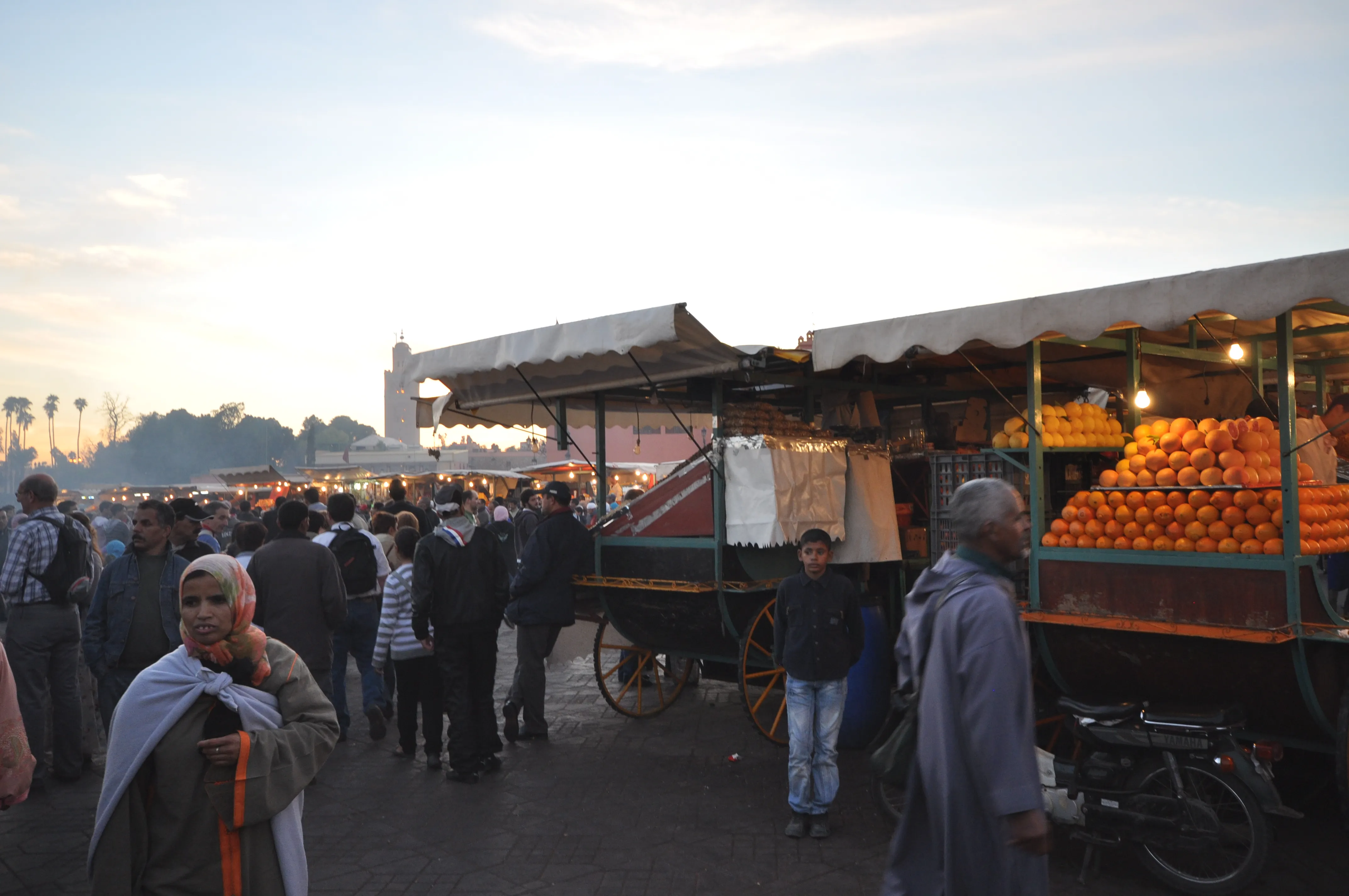
- Jemaa el-Fna / the medina. The ride is 15 to 25 minutes depending on traffic; call it 30 to 40 minutes door-to-door once you have found a taxi and walked in from where it drops you (cars cannot enter the pedestrian core, so you arrive at the edge and walk). This is the classic layover destination: the square, the Koutoubia minaret alongside it, the souks feeding off the top of the plaza, and a mint tea on a rooftop terrace overlooking the whole scene.
- Majorelle Garden (Jardin Majorelle) and the Yves Saint Laurent museum. In the Gueliz/Ville Nouvelle side, roughly 15 to 20 minutes from the airport, so 30 minutes door-to-door. A compact, high-impact visit: the cobalt-blue villa, the cactus garden, and the adjacent YSL museum. Because it is enclosed and ticketed, it is a lower-stress choice than the medina for a first-timer on the clock — though queues can form, so it suits a longer layover.
- Menara Gardens. The closest green space of note, only a few minutes from the airport, with its emblematic pavilion and reflecting pool backed by the Atlas Mountains on a clear day. It is modest but genuinely close, which makes it a defensible pick for a shorter, cautious layover.
- Gueliz (new town) cafes and shops. If you just want a comfortable, walkable, low-drama couple of hours — good coffee, wide boulevards, modern shops — Gueliz is 10 to 15 minutes away and asks nothing of you logistically.
A word on the return leg, which travellers routinely underestimate. Always plan your return taxi backwards from your onward check-in, not from your departure time. Work out when check-in and bag drop close (commonly 45 to 60 minutes before departure for international flights), subtract the return ride and immigration/security time, and leave the medina at that moment regardless of how good the tea is. From Jemaa el-Fna, that usually means heading back at least two hours before your flight departs. Taxis are easy to find at the square’s edges and on the main roads around it; if you are nervous, ask the cafe or riad where you stopped to call one for you.
What to do inside the airport on a short layover
If your layover is genuinely short, or it is the middle of the night, or you simply do not fancy the hassle, Marrakech-Menara is a perfectly civilised place to wait it out. The terminal is modern, bright and reasonably well provisioned, with the usual mix of cafes, snack outlets and shops on both the landside and airside.
Practical ways to pass a short stop:
- Eat and drink. There are cafes and fast-food style outlets both before and after security. Airport prices apply, but a coffee, a sandwich and a sit-down are easy to come by. If you have not yet passed security, you have more choice landside.
- Shop. Duty-free and souvenir outlets carry the predictable range — argan oil, spices, sweets, leather trinkets — if you want a last-minute gift without going into town. Prices are higher than the souks, but the convenience is the point.
- Charge and connect. Buy a local SIM or eSIM at an operator desk on arrival if you want reliable data, and use the airport Wi-Fi for the wait. Charging points exist but can be scarce at busy gates, so a power bank is worth having.
- Prayer rooms and quiet corners. As you would expect in Morocco, there are prayer facilities in the terminal, and quieter seating areas away from the main flow if you want to rest.
- The architecture itself. Menara’s terminal is architecturally notable, with its geometric, mashrabiya-inspired white lattice screens filtering the light — a pleasant thing to sit under for an hour with a coffee.
For an exhaustive rundown of what is where — ATMs, SIM desks, food, the layout of the piers — the terminals and facilities guide is the place to go.
Lounges: are they worth it?
Marrakech-Menara has airport lounges in the departures area, and for a long or awkward layover they can transform the experience. A lounge typically offers comfortable seating, complimentary food and drink, Wi-Fi, washrooms and a quieter atmosphere than the general gate area. Access usually comes through one of a few routes:
- Business or first-class tickets on airlines that use the lounge.
- Frequent-flyer or alliance status that grants lounge access.
- Lounge membership programmes and certain travel credit cards that bundle access.
- Pay-at-the-door or pre-booked entry, where the lounge sells single visits to anyone, often bookable online in advance for a fixed fee.
Whether it is worth it comes down to arithmetic. If you have a five-hour night-time layover, no desire to go into town, and the alternative is a hard bench, a paid lounge visit can be excellent value for the food, comfort and a shower if one is available. If your layover is short or you are heading into the city anyway, skip it. Check current access rules and prices directly with the lounge or a lounge-booking service before you rely on entry, because eligibility and opening hours change, and lounges occasionally reach capacity.
Transit rules and connecting flights
This is the section that decides whether your layover is relaxing or stressful, so read it carefully and then confirm everything with your own airline.
Through-checked bags and single tickets. If you booked both flights on one ticket (or a properly connected itinerary), your checked bag is usually tagged through to your final destination and you are issued both boarding passes. In that happy case, a pure airside connection is conceivable — but remember Marrakech’s layout means you may still pass through security and, depending on the routing, immigration. Ask at your first check-in whether your bag is through-checked and whether you need to clear immigration on connection.
Separate tickets. If you booked two independent tickets, assume the worst: you must collect your checked bag, clear immigration into Morocco, re-check in for the second flight, and clear security and departure control again. This is not optional and it is time-consuming, which is exactly why very short “self-connect” layovers on separate tickets are risky. Build in a generous buffer, and if it is tight, that is a strong argument for a single through-ticket instead.
Terminal and gate logistics. Marrakech-Menara is not a sprawling mega-hub; walking distances are manageable and there is essentially one main passenger terminal complex. That simplicity works in your favour on a connection — you are unlikely to face a long inter-terminal transfer — but it does not remove the immigration and security steps described above.
Minimum connection time. Every airport publishes a minimum connection time (MCT), and your airline enforces its own. If your itinerary was sold as a single connection, the airline has judged it legal, but legal is not the same as comfortable. For a self-arranged connection, give yourself far more than the theoretical minimum, especially if you intend to leave the terminal.
Overnight layovers. If you are stuck overnight, decide early whether to stay in the terminal or book a room. A nearby airport hotel or a riad near Jemaa el-Fna can turn a miserable night on a bench into a shower, a bed and a chance to see the square lit up after dark — often for a very reasonable price. Just apply the same return-buffer discipline in the morning, when traffic and thin early taxi supply can catch you out.
Whatever your configuration, the golden rule holds: verify with your airline. Baggage handling, immigration requirements on connection, and minimum connection times are airline- and routing-specific, and no general guide can substitute for the answer from the carrier holding your ticket.
A sample plan: the ideal six-hour daytime layover
To make this concrete, here is how a comfortable six-hour daytime layover might unfold, purely as an illustration:
- Land and clear immigration (allow up to 45 minutes). Have your passport and onward boarding pass ready.
- Deal with luggage (10 to 20 minutes). Confirm your bag is through-checked, or store it at the consigne, or keep a single small carry-on.
- Taxi to Jemaa el-Fna (30 to 40 minutes door-to-door). Agree the fare first.
- Ninety minutes in the medina. Mint tea on a rooftop terrace, a loop of the square and the top of the souks, a look at the Koutoubia, one or two small souvenirs.
- Optional quick lunch (45 minutes). A tagine or a bowl from a reputable spot rather than a stall if your stomach is cautious before flying.
- Return taxi, leaving at least two hours before departure (30 to 40 minutes).
- Immigration, security and bag re-check (up to an hour). Then relax at the gate or a lounge with margin to spare.
That itinerary uses the full six hours honestly, with real buffers rather than optimistic ones, and it is the pattern most layover travellers should aim to copy or shorten — never stretch.
Explore more
If Marrakech charms you on this brief visit — and it tends to — the medina and its beating heart, Jemaa el-Fna, reward a proper trip. Our home page links to detailed independent guides on the square, the souks, the food, the scams to sidestep and the best times to visit, so you can plan a full stay rather than a stolen afternoon.
Frequently asked questions
Is it worth leaving Marrakech airport during a layover? Yes, if your layover is six hours or more and you hold a visa-free passport, because the medina is only 5 to 6 km away and a taxi reaches it in 15 to 25 minutes. Under four hours, stay inside: immigration queues, luggage and the return journey leave too little margin.
Do I need a visa to leave the airport for a few hours? Citizens of many countries — including the UK, EU states, the US, Canada, Australia and New Zealand — can enter Morocco visa-free for up to 90 days, so no separate transit visa is needed to step out for the day. There is no sterile transit zone, so you must clear immigration to reach the exit. Always confirm your own nationality’s rules with an official source before relying on this.
How long do I need for a quick trip to Jemaa el-Fna and back? Budget around three to three and a half hours of your layover for a genuine medina visit: roughly 30 to 40 minutes each way door-to-door, immigration and security on both sides, and at least an hour or so actually in the square. That is why six hours is the comfortable threshold.
Can I store my luggage at Marrakech airport? There has historically been a left-luggage service, but its availability and hours vary, so verify it on arrival at the information desk. Alternatives include leaving a through-checked bag with your onward airline, a luggage-storage shop in the city, or simply travelling with a single carry-on you keep with you.
How much does a taxi from the airport to the city cost? Fares vary and overcharging on arrival is common, so agree the price or insist on the meter before your bags go in. Our airport-to-city-centre guide breaks down realistic prices and the scams to avoid.
What can I do inside the airport if my layover is short? Use the cafes and snack outlets, browse duty-free and souvenir shops, pick up a local SIM or eSIM, use the Wi-Fi, find a prayer room or quiet corner, and — if eligible or willing to pay — settle into a departures lounge.
Are there lounges at Marrakech-Menara, and how do I get in? Yes, there are lounges in departures. Access comes via business/first tickets, frequent-flyer status, certain credit cards or membership programmes, or a pay-at-the-door/pre-booked single visit. Check current prices and opening hours before you count on entry.
What happens if my two flights are on separate tickets? Assume you must collect your checked bag, clear immigration into Morocco, re-check in for the second flight and pass security again. That takes real time, so give yourself a generous buffer and confirm the details with both airlines.
This is an independent, indicative guide and is not affiliated with Marrakech-Menara Airport or any airline. Times, prices, visa conditions and services change; always confirm against official sources — for example the Moroccan National Tourist Office and the ONDA airports authority — and with your own airline before you travel.