Renting a car at Marrakech-Menara Airport (code RAK) is straightforward: the rental desks are grouped together in the arrivals hall of Terminal 1, both major international names (Europcar, Hertz, Avis, Sixt, Budget, Enterprise) and a long list of Moroccan agencies sit side by side, and a small economy car typically costs somewhere between 250 and 500 MAD per day (roughly €25 to €50) depending on the season, the length of hire and how far in advance you book. To collect a car you need a valid driving licence held for at least one year, your passport, and a credit card in the main driver’s name for the security deposit. An International Driving Permit (IDP) is not strictly required for most licences but is strongly recommended and occasionally requested.
The single most important thing to understand before you book is that the advertised daily rate is rarely the price you actually pay. Insurance excess (the “franchise”), a full-to-full fuel policy, the deposit blocked on your card, young-driver surcharges and one-way fees can double a cheap quote. This guide walks through exactly where the desks are, whether to book online or on arrival, realistic 2026 prices, how insurance and excess really work, the documents you need, and — just as important — what it is actually like to drive in Marrakech and across Morocco: the rules, the police checkpoints, fuel, parking and the mopeds.
All prices below are given as an indication for 2026 and can change with season and demand. This is an independent guide: we are not affiliated with any rental company and recommend none in particular.
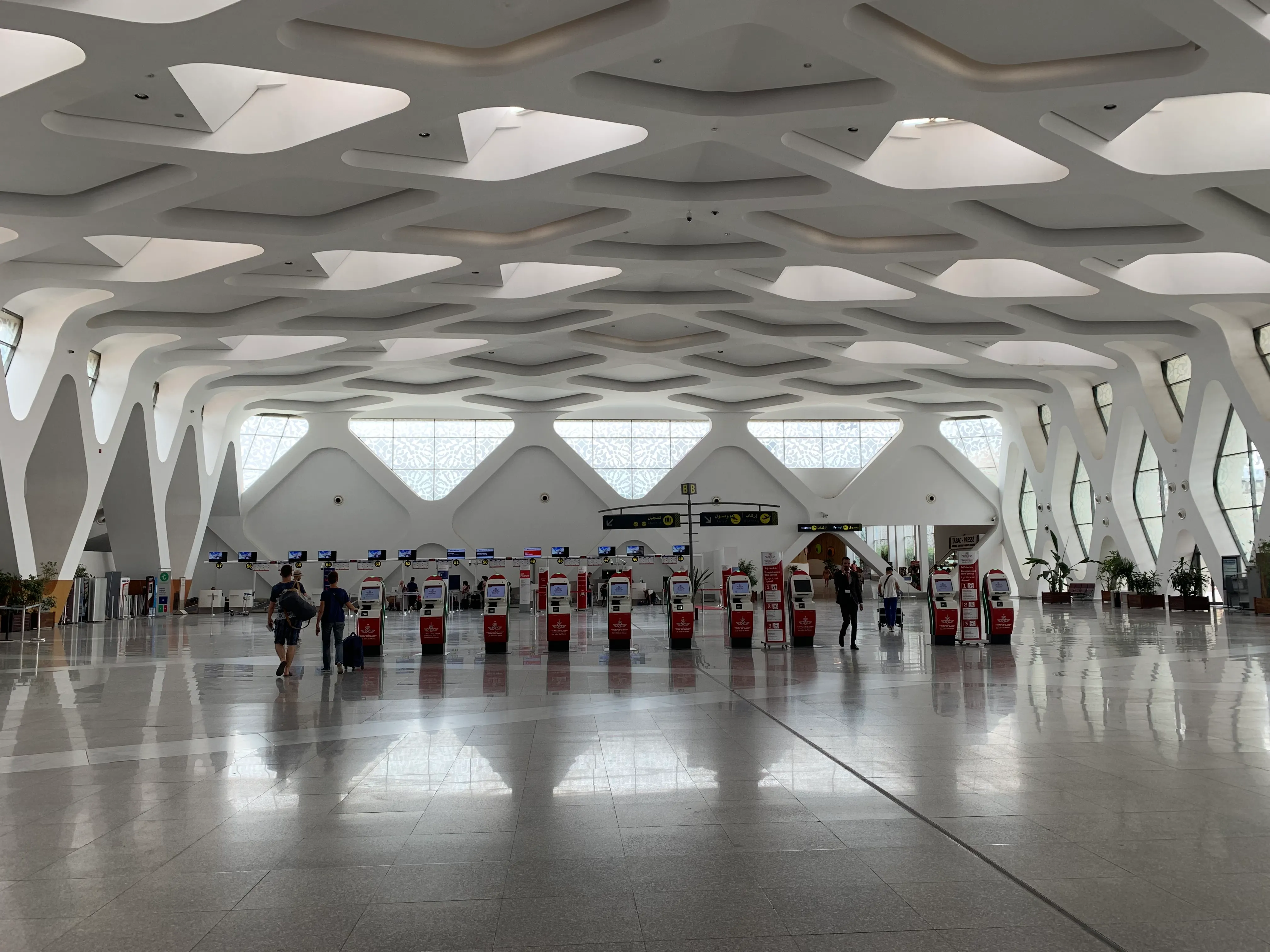
Is renting a car at Marrakech Airport worth it?
For getting around the medina and the city centre of Marrakech itself, a car is more of a burden than a help. The old town is a maze of narrow, often pedestrian lanes where no car can go, parking is scarce and traffic is dense. If your trip is Marrakech-only, you are better off with taxis, and you can read our dedicated comparison on getting from Marrakech Airport to the city centre.
A rental car earns its keep the moment you want to leave the city: the Atlas Mountains and the Ourika Valley, Essaouira on the coast, the Agafay desert, Ait Ben Haddou and Ouarzazate over the Tizi n’Tichka pass, or a longer loop toward the dunes. For those trips the freedom of your own vehicle, on your own schedule, is hard to beat — and often cheaper than repeated private drivers or organised tours if there are two or more of you.
So the honest answer is: rent a car for the road trips, not for the city. Many visitors even pick up the car on the day they leave Marrakech and drop it back on their return, spending the in-town days on foot and by taxi.
Which car rental companies operate at RAK?
Marrakech-Menara is one of Morocco’s busiest airports, and the rental market reflects that. You will find the familiar international brands alongside a large number of Moroccan agencies, many of which are perfectly reputable and noticeably cheaper. The table below summarises the main players and what to expect from each category. Rates are indicative low-season starting points for a small economy car, booked in advance.
| Company | Type | Desk at RAK | Indicative from (per day) | Notes |
|---|---|---|---|---|
| Europcar | International | Arrivals hall | ~€30-45 | Wide fleet, consistent standards, higher excess |
| Hertz | International | Arrivals hall | ~€30-45 | Well-known, airport counter, English spoken |
| Avis | International | Arrivals hall | ~€30-45 | Reliable, clear terms, deposit on credit card |
| Sixt | International | Arrivals hall | ~€28-45 | Often competitive online, newer cars |
| Budget | International | Arrivals hall | ~€28-40 | Value arm of Avis group |
| Enterprise / National | International | Arrivals hall | ~€30-45 | Good service reputation |
| Goldcar / Firefly | Broker/value | Arrivals hall or shuttle | ~€20-35 | Cheap headline rates, upsells on arrival |
| Medloc, Karim’s Car, Amarrakech, First Car, local agencies | Moroccan | Arrivals hall / nearby | ~€18-35 | Often cheapest, quality varies, read reviews |
A few practical notes on the categories:
- International chains give you predictability: standardised contracts, a recognisable counter, roadside assistance and easy cross-checking of reviews. You usually pay a little more, and their standard excess (deductible) can be high — sometimes €1,000 or more — which they will offer to reduce with paid insurance at the desk.
- Reputable Moroccan agencies can be excellent value and just as professional, with staff used to tourists. The catch is variability: read recent, detailed reviews, confirm the car category, and inspect the vehicle carefully. A named, well-reviewed local agency is often the sweet spot for a Morocco road trip.
- Ultra-cheap broker rates (the ones that look too good on comparison sites) frequently rely on selling you excess-reduction insurance at the counter and on strict fuel or deposit rules. The headline price is real; the total often is not.
Where do you collect the car at the airport?
All the rental counters are inside the arrivals hall of Terminal 1, the main terminal, after you clear passport control and baggage claim and walk out into the public area. They are generally lined up together, clearly signed with company logos, so you can compare desks in person if you have not pre-booked.
The collection process is:
- Present your voucher (if booked online), passport, driving licence and the credit card for the deposit.
- The agent prepares the contract; read the fuel policy, excess amount and mileage limit before signing.
- The deposit (often €800-€1,500, sometimes more) is pre-authorised/blocked on your credit card.
- You are taken to the car. For a few agencies the vehicles sit in a nearby lot and a staff member walks or shuttles you across.
Do the vehicle inspection seriously. Walk around the car with the agent, photograph and film every existing scratch, dent, wheel and the windscreen, note the fuel gauge, and make sure every mark is written on the contract before you drive off. This five-minute habit is your best protection against a disputed damage charge at drop-off. For orientation around the rest of the airport, our Marrakech Airport practical guide covers terminals, ATMs and SIM cards.
Booking online in advance vs renting on arrival
You have two routes, and they suit different travellers.
Booking online in advance is what we recommend for most people, especially in high season (spring, autumn, Christmas and Easter). The advantages:
- Lower prices — pre-booked rates are usually cheaper than walk-up prices.
- Guaranteed availability — during peak weeks the airport can genuinely run low on cars, particularly automatics and larger vehicles.
- Time to read the terms — you can compare fuel policies and excess calmly instead of at a busy counter.
- A written quote to hold the agency to.
Book directly on the company’s own site or through a well-known comparison platform, and print or screenshot the voucher including the total price and the included insurance.
Renting on arrival can still work, and occasionally lands a bargain in low season when agencies compete for walk-ups. The risks are higher prices, no guarantee the category you want is available, and the pressure of negotiating and reading a contract while tired after a flight. If you do this, still compare two or three desks rather than taking the first.
A middle path many travellers use: book a refundable/free-cancellation rate online to lock in a car and a price, then keep it unless a clearly better deal appears.
How much does it really cost? A realistic budget
Here is how a typical rental adds up in 2026. Treat these as indicative ranges.
- Small economy car (e.g. Dacia Sandero, Kia Picanto, manual): ~250-500 MAD/day (€25-€50). Longer rentals and low season sit at the bottom of the range.
- Compact / small SUV (e.g. Dacia Duster): ~450-800 MAD/day (€45-€80). Popular for Atlas and desert routes.
- Automatic transmission: expect a premium of 30-60% over the manual equivalent, and book early — automatics are limited.
- Larger SUV / 4x4 / minivan: ~800-1,500+ MAD/day (€80-€150+).
On top of the daily rate, budget for:
- Fuel: petrol and diesel run roughly 12-16 MAD/litre in 2026. Diesel is usually a little cheaper and most rental cars are diesel.
- Excess-reduction insurance (if you buy it at the desk): often €8-€20 per day — sometimes more than the car itself.
- Young-driver surcharge: common for drivers under 21-25.
- Additional driver fee, one-way fee, airport/premium location fee, and child seats (~€5-€10/day).
- Tolls: Morocco’s motorways (autoroutes) are tolled but cheap by European standards — a few dozen dirhams between cities.
- Parking: guarded street parking costs a few dirhams; hotel or paid car parks more (see below).
The lesson: a “€25 a day” car can realistically cost €45-€60 a day all-in once fuel, insurance and extras are counted. Build the total, not the headline, into your trip budget.
Insurance and the excess (franchise): the part that catches people out
This is the single biggest source of unpleasant surprises, so it is worth understanding properly.
Every rental in Morocco comes with basic third-party insurance (legally required) plus, usually, Collision Damage Waiver (CDW) and Theft Protection. But CDW almost always carries an excess (also called the deductible or franchise): the amount you are still liable for if the car is damaged or stolen. That excess is frequently €700-€1,500, and it is the sum that gets blocked on your credit card as a deposit.
You have three broad ways to handle the excess:
- Accept the excess and drive carefully. Cheapest up front. If nothing goes wrong, you pay nothing extra and the deposit is released after drop-off (this can take days to appear back on your card).
- Buy the rental company’s excess-reduction / “super CDW” at the desk. This lowers or removes the excess, but is expensive (€8-€20+/day) and is where cheap brokers make their margin.
- Buy standalone excess insurance from a third party (an independent car-hire excess policy) before you travel. This is usually far cheaper — often a few euros a day or a modest annual policy — and refunds you if you are charged. The catch: you still pay the rental company first and claim it back, so you need the deposit headroom on your card.
Key points to protect yourself:
- Check what “included insurance” actually means on any pre-booked deal — it almost never means zero excess.
- Common exclusions: tyres, windscreen, undercarriage, wheels and mirrors are often not covered by standard CDW. On rough Moroccan roads these are exactly what gets damaged, so ask.
- Never let the desk pressure you into their top-tier insurance by implying the roads are terrifying. Decide your excess strategy before you arrive.
- Keep the deposit in mind: you need a credit card (not debit) with enough available limit to absorb it.
Documents you need to rent and drive
To rent and legally drive in Morocco you need:
- A valid driving licence, normally held for at least one year (some agencies require two, and impose surcharges on younger drivers).
- Your passport (used for the contract; carry it or a copy while driving).
- A credit card in the main driver’s name for the deposit — debit cards and cash deposits are often refused.
- The rental contract and insurance (“green card”), which must stay in the car.
On the International Driving Permit (IDP): Morocco recognises many national licences, and in practice a standard EU, UK or US licence in the Latin alphabet is usually accepted by rental agencies and police. However, an IDP is cheap, translates your details, and is sometimes requested — especially at checkpoints or if your licence is not in French/Arabic/Latin script. We recommend getting one from your home country’s automobile association before travel; it is a small insurance against a big hassle. You must carry your home licence alongside the IDP — the IDP alone is not valid.
What it’s like to drive in Marrakech and across Morocco
Driving in Morocco is very doable for a confident driver, but it rewards defensive habits. A realistic picture:
- In Marrakech city, traffic is dense and assertive. Mopeds and scooters weave in every direction, often the wrong way and without lights at night — they are the number-one hazard. Junctions can feel improvised; priority is negotiated as much as signposted. Stay calm, go slowly, and expect the unexpected.
- Roundabouts: as a rule, traffic already on the roundabout has priority, but do not assume others will yield — approach ready to stop.
- Open roads and motorways are a different, far more relaxed experience. The autoroute network (Marrakech-Casablanca, Marrakech-Agadir) is modern, tolled and easy.
- Rural and mountain roads (the Tizi n’Tichka to Ouarzazate, for example) are scenic but narrow, winding and shared with trucks, buses and the occasional animal. Drive in daylight, use your horn on blind bends as locals do, and don’t rush.
Rules of the road
- Drive on the right.
- Seatbelts are mandatory front and rear.
- Speed limits (general): 60 km/h in town, 100 km/h on open roads, 120 km/h on motorways — always obey posted signs, which change frequently near villages.
- Using a handheld phone while driving is prohibited.
- Alcohol: the limit is effectively very low; don’t drink and drive.
- Speed is enforced with radar and mobile checks, and fines for speeding are common and issued on the spot.
Police checkpoints (contrôles)
You will pass Gendarmerie Royale checkpoints on intercity roads — this is completely normal and usually a non-event. A few tips:
- Slow down and be ready to stop whenever you see officers at the roadside; watch for other cars braking.
- Most of the time you are waved through. If stopped, be polite, greet the officer, and have your licence, passport, rental contract and insurance ready.
- Fines for genuine offences (speeding, missed stop) are typically a set amount paid on the spot with a receipt. Ask for the receipt.
- Obey temporary and hidden speed limits near checkpoints and villages — a sudden drop to 40 km/h before a radar is a classic catch.
Fuel
- Filling stations (Afriquia, Shell, Total, Winxo and others) are plentiful on main roads and in cities, but can be sparse on remote desert and mountain routes — fill up before long empty stretches.
- Most are full-service: an attendant pumps the fuel; a small tip is appreciated but not required.
- Pay attention to your rental’s fuel type (usually diesel/gasoil) — putting petrol in a diesel is an expensive mistake.
- The standard rental fuel policy is “full-to-full”: you collect it full and return it full. Avoid “full-to-empty” deals, where you prepay a tank and lose whatever you don’t use.
Parking
- In Marrakech, look for guarded parking lots and the ubiquitous gardiens (parking wardens in blue coats) who watch cars on the street for a few dirhams (around 5-20 MAD by day, a bit more overnight). Pay them; it is normal and keeps your car safe.
- Do not leave valuables visible in the car.
- Many riads have no parking of their own; ask your accommodation in advance where to leave the car — they usually know a nearby guarded lot.
- Never block medina lanes or park where locals clearly don’t.
One-way rentals and day trips
One-way rentals (pick up in Marrakech, drop off elsewhere — say Agadir, Fez or Casablanca) are possible with the larger companies but usually carry a one-way drop fee, which can be significant. If your itinerary is a loop back to Marrakech, a standard return rental is far cheaper. Always get the one-way fee quoted in writing before booking.
Day trips by car are where a rental shines. Popular self-drive days from Marrakech include:
- Ourika Valley and the Atlas foothills — about an hour out, waterfalls and Berber villages.
- Agafay “desert” — rocky lunar landscape under an hour away.
- Essaouira — the breezy Atlantic port, ~2.5 hours each way (very doable as a long day, better overnight).
- Ait Ben Haddou and Ouarzazate — over the spectacular Tizi n’Tichka pass; a long day, and more comfortable with a night in Ouarzazate.
For any mountain or desert day, start early, carry water, keep the tank topped up, and plan to be off winding roads before dark.
Renting a car vs taking taxis and transfers
To decide honestly, weigh the two approaches:
Choose a rental car if you plan to explore beyond Marrakech, value independence and flexible timing, are travelling as a couple or group (splitting costs), and are comfortable with assertive traffic. Over several out-of-town days it is frequently cheaper and always more flexible than hiring drivers repeatedly.
Stick with taxis and transfers if your trip is Marrakech-focused, you would rather not drive in busy North African traffic, you are travelling solo (where a car’s cost isn’t shared), or you only need the occasional excursion — for which a private driver for the day (often €60-€120 depending on distance) removes all the parking, navigation and checkpoint stress.
Many travellers combine both: taxis in the city, a rental car (or a driver) for the road trips. For the arrival leg specifically, see our comparison of getting from Marrakech Airport to the city centre, and browse the rest of our travel guides on the home page.
For official reference on rules and paperwork you can consult your own country’s automobile association for the International Driving Permit, and general safety and entry information via a government travel-advice service such as the UK FCDO Morocco travel advice.
Frequently asked questions
Do I need an International Driving Permit to rent a car in Marrakech?
For most EU, UK and US licences, no — a valid national licence in the Latin alphabet is generally accepted by rental agencies and police. That said, an IDP is inexpensive, sometimes requested at checkpoints, and required if your licence is not in a familiar script. We recommend getting one and carrying it alongside your home licence.
How much does it cost to rent a car at Marrakech Airport?
As an indication for 2026, a small economy car starts around 250-500 MAD per day (€25-€50) when booked in advance, with compacts and SUVs higher and automatics carrying a premium. Remember to add fuel, any excess-reduction insurance, and possible extras — the all-in cost is typically noticeably above the headline rate.
Is it better to book online or rent on arrival?
Book online in advance in most cases, especially in high season: prices are lower, availability is guaranteed, and you can read the terms calmly. Renting on arrival can occasionally beat walk-up deals in low season, but you risk higher prices and sold-out categories. A free-cancellation online booking gives you the best of both.
What is the “excess” and should I pay to reduce it?
The excess (franchise/deductible) is the amount you remain liable for if the car is damaged or stolen — often €700-€1,500, and it is blocked on your card as a deposit. You can accept it and drive carefully, buy the desk’s expensive excess-reduction cover, or — usually cheapest — buy standalone excess insurance before you travel and claim back any charge.
Is it safe and easy to drive in Marrakech?
Driving on Morocco’s open roads and motorways is easy and pleasant. Marrakech city traffic is busier and more assertive, with mopeds the main hazard — manageable for a confident, defensive driver but not relaxing. Many visitors avoid driving inside the city entirely and use the car only for trips out of town.
What happens at police checkpoints?
Gendarmerie checkpoints on intercity roads are routine. Slow down, be ready to stop, and most of the time you are waved through. If stopped, be polite and have your licence, passport, rental contract and insurance ready. Genuine fines are paid on the spot with a receipt — always ask for one.
Can I do a one-way rental or drop the car in another city?
Yes, the major companies offer one-way rentals (for example dropping in Agadir, Casablanca or Fez), but they add a one-way drop fee that can be significant. If your route loops back to Marrakech, a standard return rental is much cheaper. Get the one-way fee quoted in writing before you book.
Do I need a credit card for the deposit?
Yes. The security deposit is pre-authorised on a credit card in the main driver’s name, and debit cards or cash are usually refused. Make sure your card has enough available limit to cover both the deposit and the insurance excess, as both can be blocked until the car is returned and inspected.