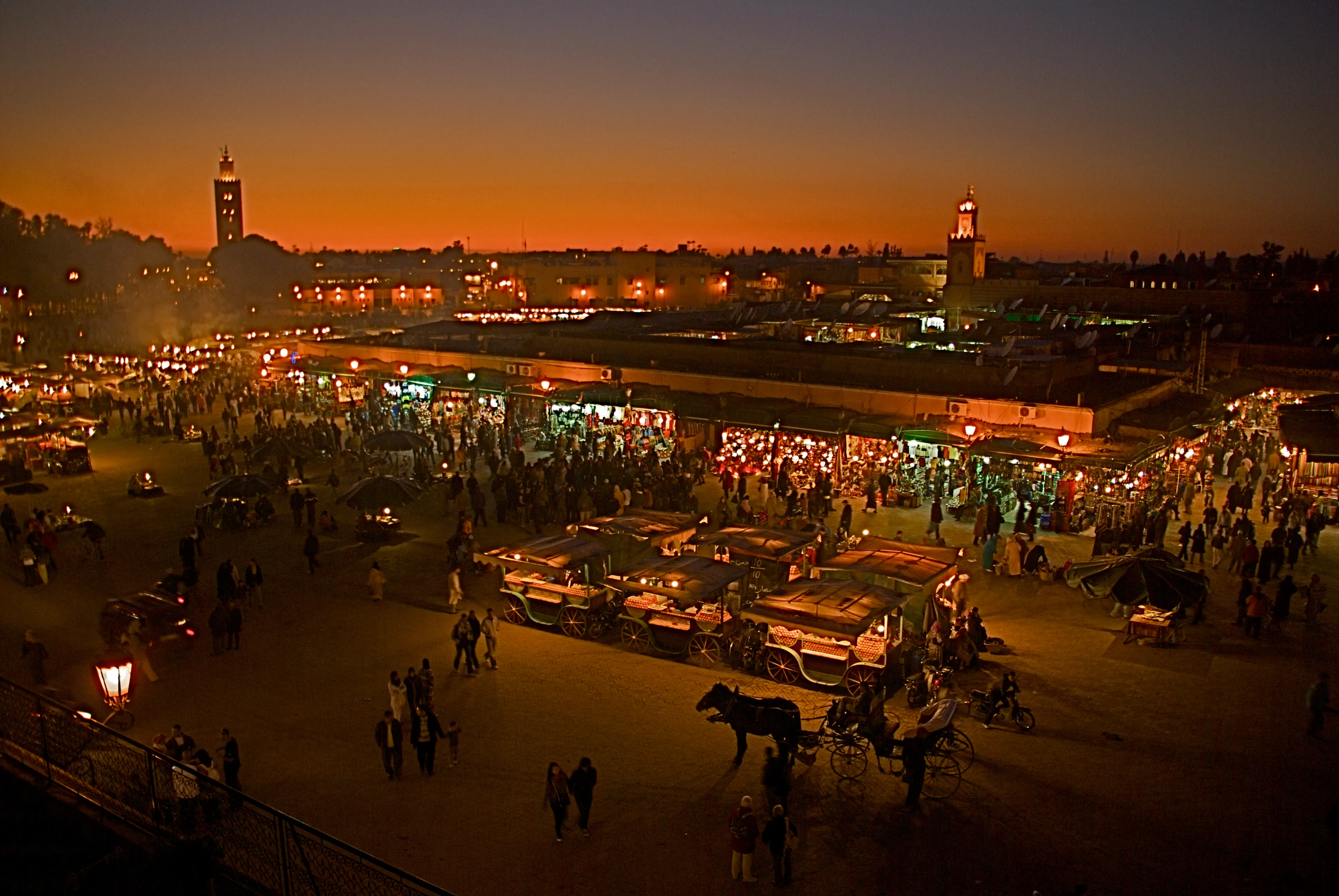
Marrakech-Menara Airport (RAK) operates around the clock, so a flight that lands at 2 a.m. or departs at 5 a.m. is perfectly normal here. The building itself never fully closes: aircraft arrive and leave through the night, immigration and baggage reclaim stay staffed for scheduled flights, and the airport handles the low-cost carriers that love unsociable hours. What changes at night is not whether the airport works, but what is available around it. The public No. 19 bus stops running in the evening, taxi fares carry a legal night surcharge of roughly 50%, most shops and cafés inside the terminal wind down, and the medina you are heading into is quieter and darker than the guidebooks suggest.
That gap between “the airport is open” and “everything around it is open” is exactly where late arrivals and dawn departures go wrong. Travellers assume a bus will be waiting at midnight, or that they can grab a quick coffee before a 4 a.m. check-in, or that a taxi meter will behave the same at 1 a.m. as it does at noon. None of those assumptions hold. This guide is built to close that gap: it explains what is genuinely open overnight, how to get into (and out of) the city safely when the sun is down, what you should reasonably pay, and how to survive an early-morning departure without missing your flight.
Everything here is indicative for 2026 and written from an independent standpoint — we sell nothing, we are not the airport authority, and prices, schedules and services can change without notice. Always treat times and fares as a starting point, not a guarantee, and confirm anything critical (like a night transfer) directly with your accommodation.
Quick answer: what to do for a night or dawn flight
Before the detail, here is the short version. If you land late or leave early, the single most reliable move is to arrange your transport in advance rather than improvising in a tired, dark car park. The table below matches the most common scenarios to the option that causes the fewest problems.
| Your scenario | Best option | Why |
|---|---|---|
| Landing after ~9:30 p.m. (bus 19 has stopped) | Prebooked private transfer, or official ONDA taxi desk | Fixed price, a driver waiting, no negotiation while exhausted |
| Landing 11 p.m. – 4 a.m., first time in Morocco | Prebooked transfer to your riad door | Safest way through a dark, unfamiliar medina with luggage |
| Landing late, tight budget, travelling light | Official taxi desk (prepaid) | Cheaper than a transfer, still a guaranteed fare |
| Departure 4 a.m. – 6 a.m. | Prebooked transfer out, or night taxi agreed in advance | Bus 19 does not run that early; you cannot risk it |
| Very long layover / arrive the night before a dawn flight | Sleep at an airport-adjacent hotel, not in the terminal | Terminal seating is limited and uncomfortable overnight |
| Short overnight wait, no hotel booked | Stay landside near the café area, stay visible | Facilities are limited overnight but the building is safe |
The thread running through every row is the same: the airport is open and safe, but the convenient public options are not running, so pre-arranging beats improvising. Keep that in mind and the rest of this guide is just detail.
Is Marrakech Airport open 24 hours?
Yes. Marrakech-Menara Airport is a 24/7 operational airport. It is one of Morocco’s busiest international gateways, and its flight schedule is spread across the whole day precisely because so many carriers serving it — particularly European low-cost airlines — operate flights that arrive late at night or leave at dawn to squeeze more rotations out of each aircraft. Runway operations, air traffic control, ground handling, security screening, immigration (the Police aux frontières) and customs all function overnight for scheduled traffic. A flight touching down at 1:30 a.m. is met by working passport booths and a moving baggage belt, not a locked-up building.
There is an important nuance, though. “The airport is open 24 hours” does not mean “the terminal is fully open 24 hours.” During the deep overnight window — very roughly between the last evening departures and the first pre-dawn check-ins — the passenger building operates in a reduced mode. Landside areas can be quieter, some doors are controlled, and, crucially, check-in and security do not open until a couple of hours before the first morning departures. If your flight leaves at 6 a.m., the check-in desks for it will typically open around 4 a.m., not the night before. That has direct consequences for anyone hoping to spend the whole night airside or to sleep past security — you generally cannot, because you cannot clear security until the process opens for your flight.
So the practical picture is: arrivals are handled at any hour; departures cluster around the times desks and screening open. If you are arriving, you will always be processed. If you are departing pre-dawn, plan around when check-in for your specific flight opens rather than assuming the whole airport is at your disposal all night.
Getting into the city at night
This is where late arrivals feel the difference most sharply. Marrakech-Menara sits only about 5 to 6 km from the medina and Jemaa el-Fna, so the journey itself is short — 15 to 25 minutes by car. The problem is the method, not the distance. For a full daytime breakdown of every option, see our guide on getting from Marrakech Airport to the city centre; below we focus on what actually changes after dark.
Bus No. 19 stops running in the evening
The No. 19 bus (the official airport-to-medina shuttle run by Alsa) is the budget hero of daytime arrivals — around 30 MAD for a ticket that includes a return valid for roughly two weeks. But it is a daytime service. Departures from the airport run roughly from the early morning until around 9:15 p.m., with the last useful medina-bound bus in the evening, not the middle of the night. Schedules are indicative and change seasonally, but the takeaway is firm: if you land after about 9:30 p.m., do not plan on bus 19. There will be no shuttle waiting, and standing in the car park hoping one appears is how people end up cornered by touts. Treat the bus as unavailable for any genuinely late arrival and choose a taxi or transfer instead.
The night taxi surcharge
Taxis are available 24/7, and after the bus stops they become the default public option. Two things matter at night. First, the meter (or the price) — Marrakech’s petits taxis are legally allowed to apply a nighttime surcharge of about 50%. A daytime airport-to-centre run that might be an indicative 70–150 MAD therefore rises to something in the region of 150–250 MAD at night, and that is a legitimate, legal increase, not a scam. Knowing this in advance is your best defence, because it lets you separate the honest night rate from a genuine overcharge.
Second, the meter is very often “forgotten” on airport departures, day or night, and the darkness makes travellers more willing to accept whatever number is quoted. The rules do not change just because it is late:
- Agree the full price out loud, in dirhams, before you get in — and before any bag goes in the trunk. Once your luggage is loaded, your bargaining power is gone.
- Say the number in dirhams and repeat it. A common night trick is the quiet switch from dirhams to euros on arrival.
- Ignore anyone who approaches you inside the terminal offering a taxi. Real ranks and the official desk are outside; touts in the hall charge far more.
To remove the negotiation entirely, use the official ONDA taxi desk at the airport, which offers pre-booking and prepayment at a set fare. Paying a fixed price in advance is worth a great deal at 1 a.m. when you are tired and unfamiliar with local prices.
The prebooked private transfer: the calmest option
For most people arriving late, a prebooked private transfer is the best answer, and it is the one we would choose ourselves for any arrival after dark or with family. You book a driver in advance; they wait in the arrivals hall holding a sign with your name; they help with the bags; and they drive you to the edge of the medina nearest your riad for a price fixed and known before you ever leave home. There is zero negotiation at the airport — which is exactly what you want when you are exhausted and it is the middle of the night.
Indicative pricing runs around €15–€30 per vehicle (not per person), with the higher end reserved for late-night arrivals. Many riads quote something like ~€15 by day, ~€20 in the evening and ~€30 for the small hours. The extra few euros over a taxi buys away the single most stressful part of a night landing.
The simplest way to arrange one is to ask your riad or hotel to organise the transfer when you book your room. They know your arrival lane in the medina, they can send a driver who knows how to reach your derb, and a local property will often help guide you the final pedestrian stretch — because remember, no vehicle drops you on Jemaa el-Fna itself; the square and its lanes are pedestrian, so the last few metres are always on foot. Arriving to a familiar face who walks you to the door is priceless at 2 a.m.
Sleeping at the airport
Some travellers, faced with a pre-dawn flight or a long layover, consider simply staying overnight in the terminal. It is possible in the sense that the building is safe and staffed, but it is genuinely not comfortable, and you should go in with clear expectations.
Marrakech-Menara is not a dedicated “sleep-friendly” airport. Seating in the public landside areas is the standard fixed, armrest-divided type that makes lying down awkward, dedicated rest zones are limited, and the overnight ambience — cleaning, announcements, lighting, the ebb and flow of the first check-in crowds — is not restful. There is no large, well-known landside lounge open through the small hours for walk-in overnight sleepers, and, as noted, you cannot pass security to wait airside until check-in for your flight opens, so the idea of dozing in a quiet departure lounge all night generally does not work.
Our honest recommendation: if you have any choice, do not sleep in the terminal. For a dawn departure, an airport-adjacent hotel is far better value in rest terms — several hotels sit within a very short drive of Menara, some offer early-riser breakfast or a shuttle, and a few hours in a real bed before a 4 a.m. alarm beats a sleepless night on a metal bench. For a long overnight layover, the same logic applies: a nearby hotel room, even for part of the night, will leave you far more functional for the onward flight.
If you truly must stay in the building — a cancelled onward connection, a missed transfer, no room available — it is safe to do so. Stay landside near the more active café/check-in zone rather than in an isolated corner, keep your bags physically attached to you (strap through a chair leg, bag as a pillow), keep your passport and valuables on your body, and stay where staff and other passengers are visible. The risk is petty opportunism against a sleeping traveller, not the building itself; visibility and attachment neutralise most of it.
Facilities open overnight
What can you actually use inside the terminal in the small hours? Expect a reduced-service airport, not a shut one. The precise list changes with the flight schedule and with individual concession decisions, so treat this as a realistic expectation rather than a guarantee.
- Toilets and basic seating — available; these are the reliable overnight constants.
- ATMs / cash machines — generally accessible landside, useful for withdrawing dirhams for a night taxi. Have some cash before you land if you can; do not depend on a single machine working.
- Currency exchange (bureau de change) — desk hours are limited and many close overnight, so do not count on changing money at 2 a.m.
- Cafés, snack bars and shops — most operate on daytime/evening hours and are closed or minimal in the deep overnight window, reopening as the first morning departures approach. If you need food or a hot drink between roughly midnight and the pre-dawn reopening, assume you may find nothing and buy supplies before you arrive.
- Duty-free and airside retail — airside, so only relevant once you have checked in and cleared security for a morning flight; these open with the morning departure wave.
- Wi-Fi and charging — free airport Wi-Fi is generally available; charging points exist but are not plentiful, so carry a power bank.
- Prayer room, pharmacy, information desk — present at the airport but on their own, largely daytime hours; do not rely on staffed help desks overnight.
The single most useful preparation is boringly simple: arrive with some dirhams in cash and a snack/water already in your bag. That covers the two things most likely to be unavailable overnight — change and food — and removes your dependence on a café or a working ATM at an inconvenient hour.
Arriving late at night: is it safe?
For most travellers the honest answer is yes, arriving late at Marrakech is safe, provided you have planned the onward leg. Marrakech is a major tourist city used to visitors landing at all hours, the airport is orderly and staffed overnight, and the drive into town is short. The risks at night are not dramatic; they are the ordinary ones of tiredness, unfamiliarity and darkness — and every one of them is reduced by arranging your transport before you fly.
Concretely, a smooth late arrival looks like this:
- Have your ride sorted before landing. A prebooked transfer or the official taxi desk means you walk out to a plan, not into a negotiation. This is the biggest single safety upgrade you can make.
- Refuse help from anyone who approaches you inside the hall. Genuine drivers and official desks are outside or hold your name on a sign; the person tapping your shoulder by the belt with “taxi, my friend?” is a tout.
- Carry the full address of your accommodation written down, including the derb (lane) name and a phone number, and ideally a screenshot of the location. At night, in the medina’s unlit lanes, this is what lets a driver or your riad’s guide actually find the door.
- Expect the medina to be quiet. After midnight the lanes near Jemaa el-Fna are far calmer than the postcard nightlife suggests. This is normal, not a sign of danger — but it is why a transfer that walks you to your riad door beats being dropped at the medina edge to find it alone with luggage.
- Keep cash discreet and split. Have small notes ready for the fare so you are not flashing a wallet in a dark car park.
Solo travellers, families and first-timers should lean hardest toward the door-to-door prebooked transfer at night — it is the option that turns the most variables (fare, navigation, the final walk) into things someone else has already handled.
Early-morning departures: don’t miss the dawn flight
Dawn departures are their own discipline, and the mistakes here are the ones that actually make people miss flights. The core problem is that the two things you rely on daily — the bus and a relaxed run to the airport — are not available before dawn. Bus 19 does not run at 4 a.m., so your only realistic options for a pre-dawn departure are a taxi arranged the night before or, better, a prebooked transfer out. Do not assume you can flag something at 4 a.m.; lock it in the evening before.
A few rules make a 5 or 6 a.m. flight painless:
- Arrange your outbound ride the night before. Ask your riad to book a taxi or transfer for a specific time, agree the (night-rate) price then, and confirm the pickup point — remember a car cannot reach the pedestrian square, so you may need to walk to a nearby pickup lane. Building in five extra minutes for that walk in the dark matters.
- Know when check-in and security open. For an early flight, desks typically open around two hours before departure and close 40–60 minutes before. There is no benefit to arriving at 2 a.m. for a 6 a.m. flight — you will simply wait landside, because you cannot clear security until it opens for your flight. Aim to be at the airport when check-in opens, roughly two hours before, which for international departures is the sensible target anyway.
- Do online check-in and carry-on only if you can. If you already have a boarding pass and no bag to drop, you skip the desk entirely and only need security to open — a real time saver at dawn.
- Have dirhams for the ride and a snack packed, because, as covered above, the café you were counting on may not be open when you leave.
- Reconfirm your driver the evening before and get a phone number. A no-show driver at 4 a.m. with the bus not running is the nightmare scenario; a confirmed pickup and a number to call removes it.
For the full walk-through of terminals, check-in, security and timing, see our dedicated Marrakech Airport departures guide, which covers the departure process in detail. And for orientation across all of the airport’s services, the Marrakech Airport homepage and guides hub links everything together.
A few final practical notes
Two external references are worth bookmarking before a night or dawn flight. For the authoritative view of the airport itself — live-ish flight information, terminal facts and official services — the National Airports Office runs the ONDA official airport portal. And for general pre-travel safety and entry guidance to Morocco, a government travel-advice page such as the UK Foreign Office Morocco travel advice is a sensible, independent reference to check close to your trip.
Beyond that, the habits that make night and dawn flights easy are unglamorous and effective: carry dirhams in cash, pack a snack and water, write down your riad’s full address with a phone number, arrange transport before you travel, and expect a legal night surcharge on taxis rather than a free ride. Do those five things and the fact that your flight lands at 2 a.m. or leaves at 5 a.m. stops being a problem at all.
Everything above is indicative for 2026 and independent — we are not the airport, an airline or a taxi company, and schedules, fares and services change. Confirm the details that matter most (your transfer, your flight’s check-in time) directly with your accommodation and airline before you fly.
Frequently asked questions
Is Marrakech Airport open 24 hours?
Yes. Marrakech-Menara Airport (RAK) operates 24/7, handling flights that arrive and depart through the night. Arrivals are processed at any hour — immigration and baggage reclaim stay staffed for scheduled flights. The nuance is that the terminal runs in a reduced-service mode overnight, and check-in and security for a given flight only open about two hours before its departure, so you cannot wander airside all night. The building is open; the shops and public transport around it largely are not.
How do I get from the airport to the city if I land in the middle of the night?
Bus 19 has stopped for the night, so your options are a taxi or a prebooked private transfer. The calmest choice is a transfer arranged in advance through your riad — a driver waits with your name and takes you to your accommodation for a fixed price. On a budget, use the official ONDA taxi desk for a prepaid, guaranteed fare. If you take a street taxi, agree the exact price in dirhams before you get in and load your bags, and expect a legitimate night surcharge.
How much more does a taxi cost at night in Marrakech?
Petits taxis are legally allowed a nighttime surcharge of about 50%. A daytime airport-to-centre run of an indicative 70–150 MAD therefore rises to roughly 150–250 MAD at night. That increase is legal and normal — not a scam. What is a scam is a vague price that inflates after your bags are loaded, or a quiet switch from dirhams to euros. Fix the exact figure in dirhams before the doors close, or use the official prepaid desk to avoid negotiating altogether.
Does the No. 19 airport bus run at night?
No. Bus 19 is a daytime service, running roughly from early morning until about 9:15 p.m. from the airport. If you land after around 9:30 p.m. or need to leave for a pre-dawn flight, the bus is not an option — plan on a taxi or a prebooked transfer instead. Do not stand in the car park hoping a late bus appears; there won’t be one.
Can I sleep at Marrakech Airport?
You can stay in the building safely, but it is not comfortable — seating is the fixed, armrest-divided kind, there is no large overnight lounge for walk-ins, and you cannot pass security to wait airside until your flight’s check-in opens. For a dawn departure or long layover, an airport-adjacent hotel is a far better use of the night. If you must stay, remain landside near the busier café/check-in area, keep your bags physically attached to you, and keep valuables on your body.
What facilities are open overnight at the airport?
Expect the basics only: toilets, seating, ATMs, Wi-Fi and some charging are generally available. Cafés, shops and currency exchange are mostly closed or minimal in the deep overnight window, reopening as the first morning departures approach. Duty-free is airside and only relevant after you check in. The practical fix is to arrive with dirhams in cash and a snack and water already in your bag, so you don’t depend on a café or a working ATM at 2 a.m.
Is it safe to arrive in Marrakech late at night?
For most travellers, yes — provided you’ve arranged your onward transport in advance. The airport is orderly and staffed overnight, and the drive into town is short. The real risks are tiredness, darkness and unfamiliarity, all reduced by a prebooked transfer or the official taxi desk. Ignore anyone offering a taxi inside the hall, carry your riad’s full address and phone number, and expect the medina to be quiet after midnight — that calm is normal, not a warning sign.
What time should I get to the airport for an early-morning flight?
Aim to arrive when check-in opens, roughly two hours before departure, which is also the sensible target for international flights. There’s no benefit to arriving at 2 a.m. for a 6 a.m. flight — you’ll only wait landside, since you can’t clear security until it opens for your flight. Crucially, book your outbound taxi or transfer the night before with a set time and a phone number, because bus 19 doesn’t run pre-dawn and you can’t rely on flagging a ride at 4 a.m.