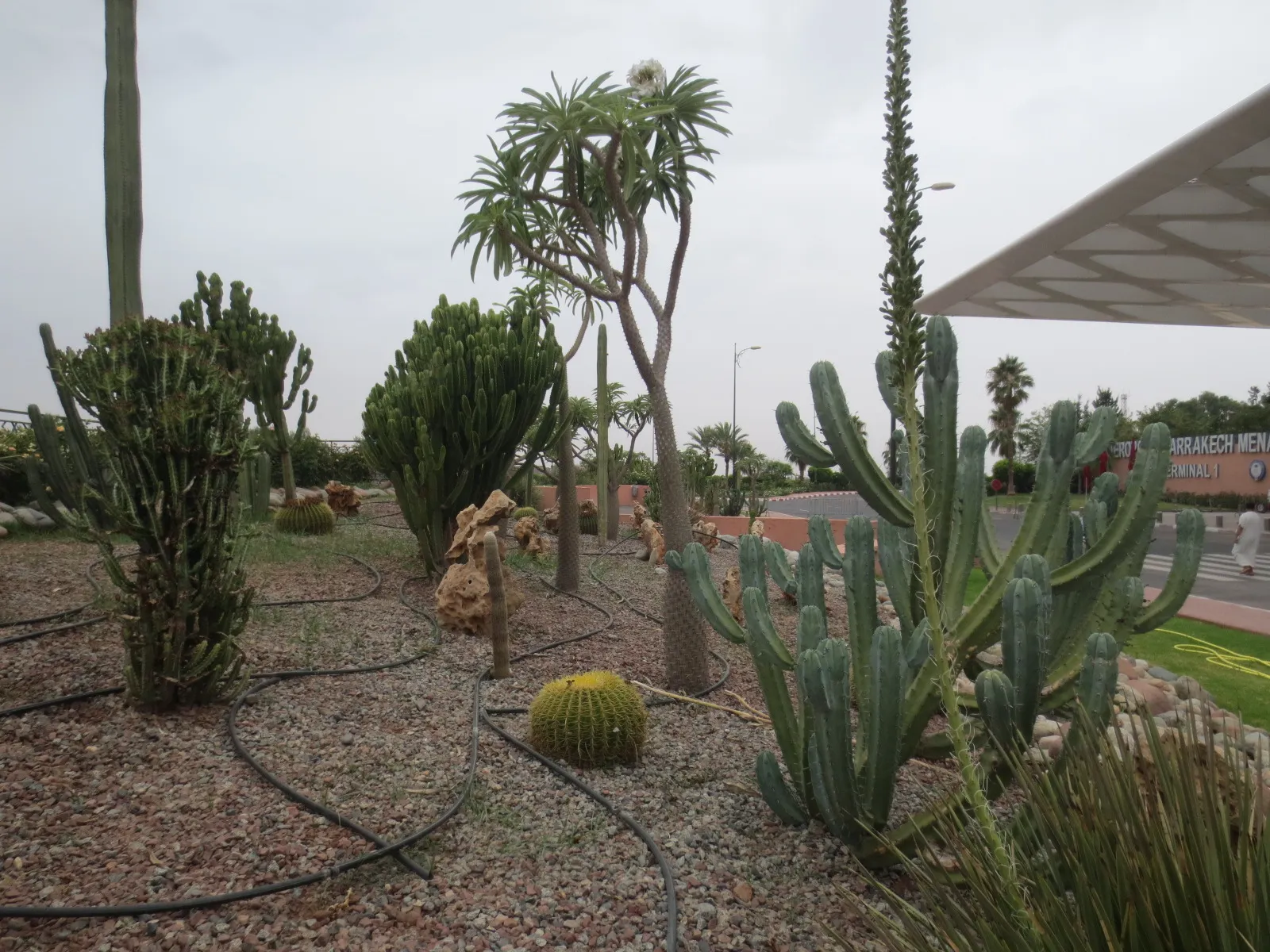
Marrakech Menara Airport (IATA code RAK) is a single, modern terminal complex with interconnected halls, and once you are inside you rarely need to leave the building to change terminals. In practical terms you will find free WiFi, several ATMs and bureaux de change, duty-free and retail shops, a spread of cafes and restaurants, at least two lounges (a Priority Pass–accessible lounge and the Royal Air Maroc Oasis lounge), a prayer room, left luggage, a pharmacy/first-aid point, and information desks with signage in Arabic, French and English. The airside and landside areas operate around the clock for flights, although individual shops and counters keep their own hours.
This guide walks through the architecture, how the terminals connect, and every facility you are likely to need, with independent, indicative tips for arriving and departing passengers. It is an unofficial travel-information resource: opening hours, prices and lounge policies change often, so treat every figure below as a guide rather than a guarantee, and confirm anything time-critical before you travel.
For step-by-step help on either side of your journey, see our companion pages on the arrivals process and the departures process. You can also browse the latest tips on our blog or return to the homepage for an overview of everything at RAK.
Facilities at a glance
The table below summarises the main services and where you will typically find them. “Landside” means before security (accessible to anyone, including people meeting passengers); “Airside” means after security and passport control, reachable only with a boarding pass.
| Facility | Typical location | Notes (indicative) |
|---|---|---|
| Free WiFi | Whole terminal, landside & airside | Network usually shown as free RAK WiFi; no password |
| ATMs / cash machines | Arrivals halls, check-in area, airside | Dispense Moroccan dirham (MAD); several banks |
| Currency exchange | Arrivals, check-in area, airside | Bureaux de change and bank counters |
| Duty-free & shops | Airside departures | Perfume, spirits, tobacco, gifts, crafts |
| Cafes & restaurants | Landside & airside | Coffee shops, snacks, sit-down options |
| Lounges | Airside departures | Pearl Lounge (pay/Priority Pass); RAM Oasis |
| Left luggage | Near arrivals / public hall | Per item, per day; ask at information desk |
| Prayer room | Terminal, signposted | Multi-faith / Muslim prayer facilities |
| Pharmacy & first aid | Terminal / medical point | First-aid station; pharmacy services |
| SIM cards / telecom | Arrivals, info desks, kiosks | Maroc Telecom, Orange, inwi providers |
| Information desks | Arrivals & public halls | Maps, guidance, some SIM/left-luggage help |
| Car hire desks | Arrivals | Major and local agencies |
| ATMs open 24/7 | Arrivals hall | For late/early arrivals |
| Toilets & baby change | Throughout | Family/baby-change facilities in restrooms |
| PRM assistance | Meeting points / desks | Reduced-mobility support on request |
Because the terminals share one connected structure, most of these services appear more than once. If the first ATM or exchange desk you pass has a long line or a poor rate, it is usually worth walking a little further to compare.
Architecture and first impressions
Marrakech Menara is one of North Africa’s most photographed airports, and the design is a deliberate showcase of Moroccan craft rather than a generic glass box. The passenger terminal is wrapped in a striking facade of diamond-shaped concrete lattice panels filled with arabesque and geometric (zellige-inspired) patterns, which throw shifting, filtered light across the check-in and departures halls during the day. Slim, angular columns and a sweeping roofline give the building a contemporary feel while keeping the ornamentation rooted in traditional Islamic geometry.
The airport takes its name from the nearby Menara Gardens, and the terminal sits only a short drive southwest of the historic medina and Jemaa el-Fna, roughly 4 to 6 kilometres from the city centre depending on your destination. That proximity is one of RAK’s practical advantages: transfers to central riads and hotels are typically quick.
Inside, the aesthetic continues with carved detailing, patterned screens and warm materials. It reads as a genuine sense of place, which is a pleasant change from the interchangeable feel of many international airports. Practically, the high ceilings and open halls make wayfinding fairly intuitive, and signage appears in Arabic, French and English throughout, so non–French speakers can navigate without difficulty.
Terminal layout and how the terminals connect
RAK is best understood as one large, interconnected terminal building rather than a cluster of separate, distant terminals. Historically the airport grew from an older hall (often referred to as Terminal 1, extensively renovated and modernised in the late 2000s, around 2008) into an enlarged complex that added further capacity (commonly labelled Terminal 2 / Terminal 3). In everyday use, passengers move between these zones inside the same connected structure, and airlines are assigned to check-in areas rather than to physically remote buildings.
What this means for you in practice:
- Check-in and departures are grouped in the landside halls, where you will find the airline desks, self-service kiosks (for some carriers), and the security screening entrance.
- Airside departures — reached after security and passport control — is where the duty-free, most shops, the main cafes, the lounges and the boarding gates are located.
- Arrivals flows in the opposite direction: passport control, then baggage reclaim, then the arrivals hall with ATMs, exchange desks, car-hire counters, SIM vendors and the exit to ground transport.
Because everything sits under one roof, connections and terminal changes are usually a matter of walking rather than taking a shuttle. If you are unsure which hall your flight uses, check the departure boards or ask at an information desk; staff generally speak French and often English.
Indicative tip: allow extra time at peak periods (early-morning European departures and the late-afternoon wave). Security and passport queues at RAK can lengthen quickly when several flights are scheduled close together.
For the full walk-through in each direction, our arrivals guide and departures guide cover queues, timing and what to expect at each checkpoint.
Free WiFi: how to connect
Marrakech Menara offers complimentary WiFi across the terminal, landside and airside, which is useful for downloading a boarding pass, calling a ride, or messaging your accommodation on arrival.
To connect:
- Open your device’s WiFi settings and look for the airport’s public network. It is usually labelled clearly as a free RAK / Marrakech Airport network.
- Select it and open your browser; a captive portal (splash page) may appear.
- Accept the terms, or enter minimal details if prompted, and you should be online. In most cases no password is required.
Realistic expectations: the free WiFi is fine for messaging, maps and boarding passes, but it can slow noticeably at busy times, and sessions may be time-limited. If you rely on a stable connection for work, or you have just landed and need data immediately, a local SIM or eSIM (see below) is the more dependable option. Lounges also provide their own WiFi, which is often faster than the general terminal network.
ATMs, cash machines and money exchange
Morocco’s currency is the dirham (MAD), which is a closed currency — you generally cannot buy meaningful amounts outside the country and you should not carry large sums in or out. That makes the airport a common place to get your first cash, so it pays to do it smartly.
ATMs / cash machines. There are several bank ATMs in the arrivals halls, around check-in, and airside. At least some operate 24/7, which matters for late-night or very early arrivals. They dispense dirham directly from a foreign debit or credit card.
Currency exchange (bureau de change). You will find exchange desks and bank counters in the arrivals area and near check-in, including well-known operators. They are convenient but not always the best value.
Independent, indicative tips to avoid poor rates:
- Compare before you commit. Rates and commissions vary between the airport desks; check the displayed rate and ask whether commission is added.
- Prefer ATMs for better rates, but watch for two separate fees: your home bank’s charge and, more importantly, the machine’s own withdrawal fee, which is disclosed on screen. Withdrawing a slightly larger amount once can beat several small withdrawals.
- Always decline “conversion to your home currency” (dynamic currency conversion) at an ATM or card terminal. Choosing to be charged in dirham almost always gives a better rate than letting the machine convert for you.
- Change only what you need at the airport. You will usually find comparable or better rates at exchange offices in the city, and cards are widely accepted at larger shops, hotels and restaurants.
- Keep small notes. Taxis, tips and small purchases are far easier with small denominations, so ask for a mix.
- Keep some cash for taxis and tips, since not every driver or small vendor takes cards.
If you are only passing through, remember you may want to spend or convert leftover dirham before departure, as it is harder to exchange once you leave Morocco.
Shops and duty-free
The main retail concentration is airside, in departures, where the duty-free stores stock the usual perfumes, cosmetics, spirits and tobacco, alongside a good selection of Moroccan gifts and crafts — argan-oil products, sweets, spices, ceramics and souvenirs — which make convenient last-minute presents. Landside, you will find newsagent-style outlets and convenience shops for snacks, drinks, travel essentials and SIM cards.
A few practical notes:
- Airport prices for crafts and food are, unsurprisingly, higher than in the medina souks; buy in the city if you have time and want to haggle.
- If you are buying liquids or gels landside (or as duty-free), keep them sealed in the tamper-evident bag with the receipt if you have an onward connection, so they clear any secondary security check.
- Card payment is widely accepted in the shops, but keep a little cash for the smallest kiosks.
Food and drink
RAK has a reasonable spread of cafes, coffee shops and restaurants on both sides of security. Landside options are handy for anyone waiting to meet an arriving passenger; airside you will find more choice once you are through, including quick snacks and sit-down bites.
Expect familiar coffee-shop staples plus some Moroccan options — mint tea, pastries and light meals. As with the shops, prices are above city levels, and choice narrows late at night and very early in the morning, so if you have a red-eye departure it is wise to eat before you arrive or to carry a snack. Bringing an empty reusable water bottle to fill after security is a sensible, cost-saving habit.
Lounges: which ones, access and cost
There are lounge options at RAK for both pay-per-visit travellers and airline premium/status passengers. Details and even opening hours change, so confirm on the day.
Pearl Lounge (airside departures). This is the lounge most independent travellers use. It typically welcomes:
- Priority Pass members (and comparable lounge-access programmes), usually with a stay limited to around 3 hours;
- Pre-booked visitors through lounge-booking services, which is often cheaper and, importantly, guarantees a seat;
- Walk-ins, subject to space, at a higher on-the-door rate.
As an indicative guide, pre-booking online has run in the region of roughly USD 25–35 per person, while walk-in rates have been around USD 50 per person, with no guaranteed entry when it is busy. Facilities generally include seating, WiFi, hot and cold snacks and drinks (including Moroccan mint tea), flight-information screens and washrooms. Note that the lounge has periodically been crowded or under renovation, so manage expectations at peak times.
Royal Air Maroc “Oasis” Lounge (airside departures). This is an airline lounge rather than a pay-in facility. Access is generally for Royal Air Maroc business-class passengers and Safar Flyer elite members, plus eligible oneworld business-class and status travellers. It does not accept Priority Pass. If you are flying RAM in a premium cabin or hold the right status, this is your lounge; otherwise, the Pearl Lounge is the route in.
Indicative tip: if a lounge matters to you (for an early departure, a long wait or a connection), pre-book online rather than gambling on a walk-in, especially in the busy spring and autumn seasons.
Left luggage (baggage storage)
If you have a late flight after check-out, or you want to explore Marrakech on a long layover, left-luggage storage is available. It is typically handled near the arrivals area or the public hall, and you are usually charged per item, per day, with the price depending on bag size. As an indicative range, small items have cost in the order of a few tens of dirham per piece per day.
Ask at an information desk for the current location, hours and price, and keep your receipt. If you are storing bags for a day trip, note the collection cut-off so you are not caught out when you return for a late flight.
Prayer room
The airport provides prayer facilities, in keeping with its role as a major gateway in a Muslim-majority country. Prayer rooms are signposted within the terminal; look for the symbols on the wayfinding boards or ask staff at an information desk. Facilities for ablution are commonly available nearby. If you need a quiet space to pray between flights, this is the dedicated option rather than using gate areas.
Medical, pharmacy and first aid
For minor issues, the airport has first-aid provision and pharmacy/medical services within the terminal. If you feel unwell, have a travel-medicine question, or need basic supplies, ask any staff member or head to an information desk, which can direct you to the medical point.
Independent tips:
- Carry essential prescription medication in your hand luggage, in its original packaging, with a copy of the prescription for anything unusual.
- Pharmacies in Marrakech city are plentiful and pharmacists often speak French; for anything non-urgent you may prefer to buy in town.
- In a genuine emergency, alert airport staff immediately so they can summon on-site medical help.
SIM cards and staying connected
Morocco has three main mobile operators — Maroc Telecom, Orange and inwi — and buying a local prepaid SIM at the airport is one of the easiest ways to get reliable data the moment you land. Vendor kiosks and, at times, information desks can help you get set up.
Practical guidance:
- Bring your passport: SIM registration is required, and staff will handle it at purchase.
- Ask for a tourist data package; these are inexpensive by international standards and usually include a generous data allowance for a week or two.
- Make sure your phone is unlocked before you travel, or consider an eSIM bought in advance if your device supports it, which lets you skip the queue entirely and land already connected.
- Compare the airport offer with operator shops in the city if you want the absolute best deal, but for convenience the airport SIM is hard to beat.
A working local number is genuinely useful in Marrakech for calling riads, confirming pickups and using ride and delivery apps.
Accessibility and reduced-mobility (PRM) assistance
RAK provides assistance for passengers with reduced mobility and disabilities (PRM). The single-building, largely step-free layout helps, and support is available on request.
- Request assistance in advance through your airline (ideally when booking, or at least 48 hours before departure). This is the most reliable way to guarantee help.
- On the day, use the designated meeting points or ask at the information/assistance desks so staff can arrange wheelchair support, help through security and passport control, and boarding assistance.
- Accessible toilets and step-free routes are provided; lifts and ramps connect levels where needed.
- Allow extra time, particularly at busy periods, so assistance can be coordinated without pressure.
If you have specific needs, describing them clearly to your airline in advance produces the smoothest experience.
Family facilities
Travelling with children is manageable at RAK. Baby-change facilities are provided within the restrooms, and the open halls make it easier to move with a pushchair. Some lounges include a children’s area, which can be a lifesaver during a long wait. Practical family tips:
- Bring snacks and water (fill bottles after security), since airside food choice narrows at off-peak hours.
- Keep entertainment and a change of clothes in your hand luggage.
- Pushchairs can usually be gate-checked; confirm the process with your airline at the gate.
Smoking
Marrakech Menara is largely a non-smoking terminal, in line with international norms. Smoking is generally restricted to designated outdoor areas landside. Some lounges have historically offered a smoking room, but this varies and should not be assumed. Vaping is treated like smoking, so use the designated areas. If in doubt, ask staff rather than lighting up indoors, where fines can apply.
Services for early-morning and late-night travellers
RAK handles a lot of early and late flights to and from Europe, so it is worth knowing what stays available at unsociable hours:
- ATMs — at least some operate 24/7, so you can get dirham on a late arrival.
- WiFi — available around the clock, handy for arranging a ride when you land at night.
- Shops and cafes — choice narrows significantly overnight; do not count on a hot meal at 3am, and carry a snack for a red-eye.
- Exchange desks — hours vary and some close overnight, so an ATM may be your only cash option late at night.
- Ground transport — pre-arranging a transfer is wise for late arrivals; agree the fare in advance if using a taxi.
Sleeping in the terminal between flights is possible but basic; seating is limited and not especially comfortable for long stays, which is another argument for a pre-booked lounge if you face a long overnight wait.
Practical summary
Marrakech Menara Airport pairs genuinely attractive, distinctively Moroccan architecture with a compact, connected single-terminal layout that is easy to navigate. The essentials are all covered — free (if sometimes slow) WiFi, plentiful ATMs and exchange, duty-free and craft shopping, a fair choice of food, a pay-in lounge plus an airline lounge, and the practical services (left luggage, prayer room, pharmacy, SIM cards, PRM assistance) that make a trip smoother. The recurring theme for value is simple: compare rates, prefer ATMs and pay in dirham, pre-book lounges, and carry small notes and a snack for off-peak hours.
For the full journey either way, continue with our arrivals guide and departures guide, keep an eye on the blog for updates, or head back to the homepage. For background reference, see the airport’s Wikipedia entry, the broader Marrakesh travel overview, and the Morocco country profile.
Frequently asked questions
How many terminals does Marrakech Airport have, and are they connected? RAK functions as one large, interconnected terminal complex. What are sometimes described as separate terminals (an older, renovated hall plus newer extensions) are joined under a single roof, so moving between check-in, security, gates and arrivals is a matter of walking rather than taking a shuttle.
Is the WiFi at Marrakech Airport free? Yes. There is complimentary WiFi throughout the terminal, usually with no password — just connect to the airport network and accept the terms on the splash page. It can slow at busy times, so a local SIM or eSIM is more reliable if you need constant data.
Where can I get cash, and should I use an ATM or an exchange desk? There are ATMs and currency-exchange counters in the arrivals halls, near check-in and airside. ATMs generally give better value, but always choose to be charged in dirham (decline “conversion to your home currency”) and note the machine’s own fee. Change only what you need at the airport; city rates are often better.
Which lounges are at Marrakech Airport and how do I get in? The Pearl Lounge (airside departures) accepts Priority Pass, pre-booked visitors and walk-ins subject to space; pre-booking is cheaper and guarantees a seat. The Royal Air Maroc Oasis Lounge is for RAM business-class and elite/oneworld status passengers and does not accept Priority Pass. Prices and hours change, so confirm on the day.
Is there left luggage at Marrakech Airport? Yes, luggage storage is available, typically near arrivals or the public hall, charged per item per day depending on size. Ask at an information desk for the current location, hours and price, and keep your receipt.
Can I buy a SIM card at the airport? Yes. Vendors for Maroc Telecom, Orange and inwi, and sometimes the information desks, can set you up with a prepaid tourist data SIM. Bring your passport for registration, and make sure your phone is unlocked — or buy an eSIM before you travel.
Is the airport open 24 hours? The airport operates around the clock for flights, and some services such as ATMs and WiFi are available 24/7. However, individual shops, cafes and exchange desks keep their own hours and choice narrows overnight, so plan ahead for very early or very late flights.
Are there prayer rooms and facilities for travellers with reduced mobility? Yes. Prayer facilities are signposted within the terminal, and reduced-mobility (PRM) assistance is available — request it through your airline in advance and use the meeting points or assistance desks on the day.
This is an independent, unofficial travel-information guide. Facilities, prices, hours and lounge policies change frequently; all figures are indicative. Please confirm current details with the airport, your airline or the relevant provider before you travel.