The short answer: since 2023, taxis at Marrakech-Menara Airport (RAK) operate on an official prepaid, fixed-fare system. You pay in advance at a counter or booth in the arrivals area, receive a ticket, and hand it to a driver at the rank. As an indication for 2026, expect roughly 150 MAD by day and 200 MAD at night for a petit taxi to the medina, Jemaa el-Fna or Gueliz, with slightly higher fixed prices for farther zones such as the Palmeraie. The night tariff (a surcharge of around 50%) usually applies between 8 pm and 6 am (20:00-06:00). Because the price is set before you get in the car, the classic “meter forgotten” or “the fare doubled once my bags were in the boot” scams largely disappear at the airport itself.
This is genuinely good news for arriving travellers. For years, the first fifteen minutes in Marrakech were a small ordeal of negotiation, touts and inflated quotes. The prepaid scheme, introduced to clean up the airport’s reputation, means you now know the cost before you leave the terminal. It is not perfect, prices still creep up year to year and there are still a few things to watch, but it removes most of the friction.
In this guide we explain exactly how the prepaid counter works step by step, give indicative fixed fares by destination in a clear table, cover the night surcharge, the difference between the petit taxi and the grand taxi, whether you can pay by card or only in cash, the handful of scams that still exist, tipping etiquette, and the cheaper or more comfortable alternatives. Every figure here is indicative for 2026 and may vary; the airport publishes official rates that can change, so treat these as a realistic guide rather than a guarantee.
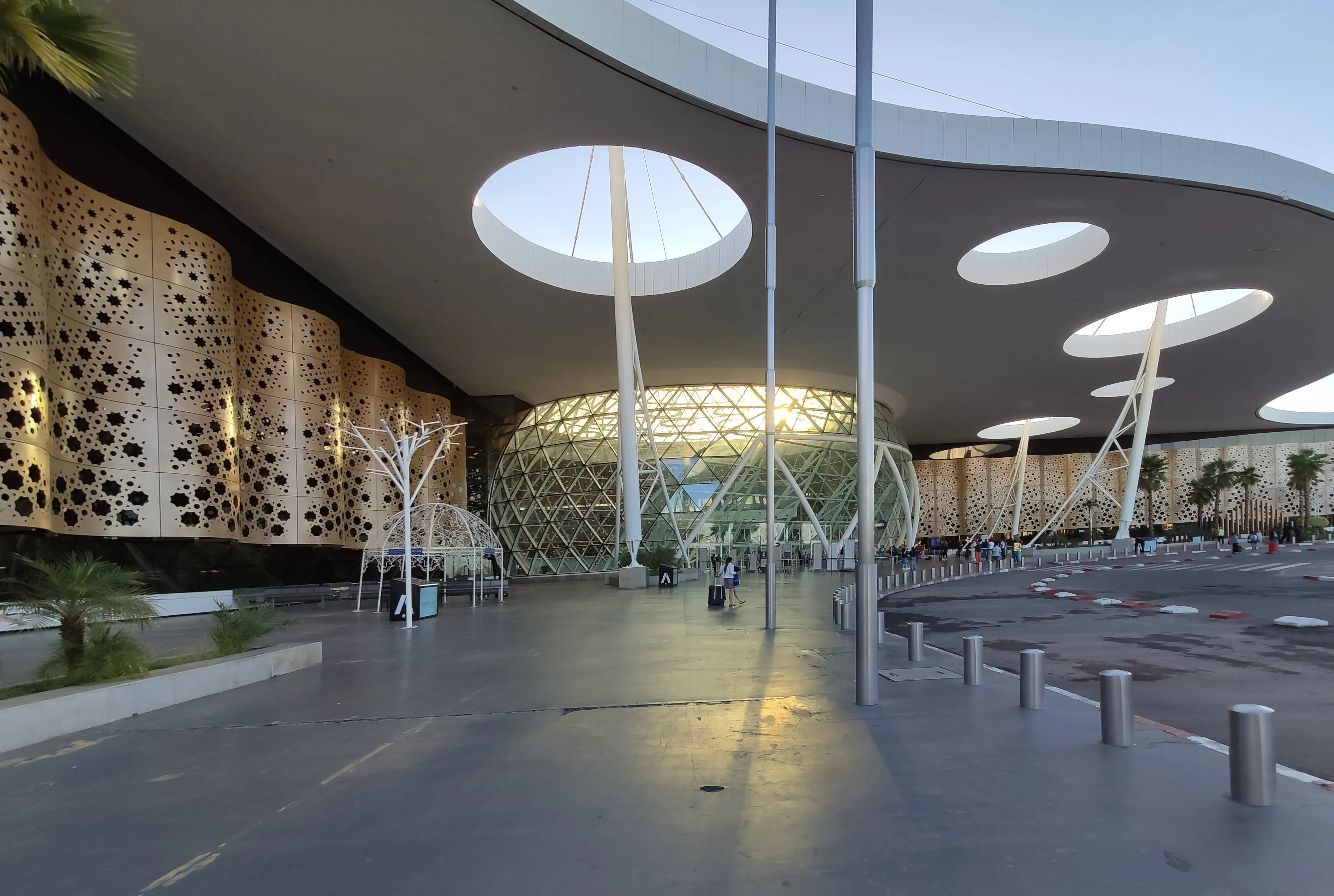
Why the airport switched to prepaid taxis
For a long time, Marrakech airport had a reputation problem. Taxis officially have meters (“compteurs”), but drivers at the airport almost never used them. Instead you negotiated, often from a position of weakness: jet-lagged, loaded with luggage, unsure of distances and unfamiliar with the currency. Quotes of 200, 300 or even 400 MAD for the short hop to the medina were common, and travellers who did not haggle hard simply overpaid. Aggressive touts inside the terminal made the first impression worse.
In 2023, the authorities and the airport operator rolled out an official fixed-fare prepaid system to bring order to the rank and protect the city’s image with visitors. The principle is simple: fares are set in advance by zone, you pay at a dedicated point, and the driver is not supposed to ask for anything more. It brings Marrakech into line with how many international airports handle taxis, and it shifts the balance of power back towards the passenger.
It is worth being clear about what the system does and does not do. It fixes the airport-to-city fare and removes the negotiation at the point where travellers were most exposed. It does not turn every taxi in Marrakech into a metered, fixed-price service, once you are in the city, ordinary taxi rules (meter or negotiation) apply again. So the prepaid scheme is best understood as a shield for the arrival, not a permanent price guarantee for your whole stay.
How the prepaid taxi counter works, step by step
The process is designed to be quick, but knowing it in advance saves confusion when you are tired. Here is what to expect on arrival.
- Clear immigration and collect your bags. Marrakech-Menara is a compact airport, so this rarely takes long outside peak periods. Have your accommodation address written down or saved on your phone, you will want to state your destination clearly.
- Find the taxi desk in the arrivals area. After the baggage hall and customs, look for a signposted taxi counter or booth, usually near the exit to the taxi rank. It may be a staffed desk or a clearly marked kiosk. If you cannot see it, ask an official in uniform, not someone who approaches you unprompted.
- State your destination (your zone). Tell the staff where you are going, Jemaa el-Fna, the medina, Gueliz, Agdal, the Palmeraie, or your hotel name. The fare is set by zone, so the exact street matters less than the district.
- Confirm the fixed price and whether it is day or night rate. The attendant tells you the fixed fare. Check whether the night surcharge applies (it normally does after 8 pm / 20:00). This is the moment to confirm the number before you commit.
- Pay and take your ticket. You pay at the counter and receive a ticket or receipt showing the fare and destination. Keep it, it is your proof of the agreed price.
- Go to the rank and give the ticket to a driver. Staff usually direct you to the next taxi in line. Hand over the ticket. The price on it is what you owe, nothing more.
- Load your luggage and confirm the destination once more. A quick “Jemaa el-Fna, oui?” avoids misunderstandings. Then you are on your way.
A few practical notes. The counter is the safest place to sort out the fare, do this before letting anyone carry your bags or lead you to a car. If a driver or “helper” intercepts you in the hall and offers to skip the counter, decline politely and head for the official desk. The whole point of the system is that the transaction happens at the counter, not curbside.
If you have pre-booked a private transfer, you skip all of this: your driver waits in the arrivals hall with a name board and you walk straight to the vehicle. More on that in the alternatives section below, and in our full guide on getting from Marrakech airport to the city centre.
Marrakech airport taxi prices by destination (2026)
The table below gives indicative fixed fares from Marrakech-Menara Airport to the main districts, by day and by night. These are realistic 2026 figures for a petit taxi (up to three passengers). Actual posted rates can differ and may be revised, so use them to sanity-check what you are quoted rather than as an exact promise.
| Destination | Distance (approx.) | Day fare (approx.) | Night fare (approx.) |
|---|---|---|---|
| Jemaa el-Fna / Medina | 5-6 km | 150 MAD | 200 MAD |
| Gueliz (new town) | 5-6 km | 150 MAD | 200 MAD |
| Hivernage | 4-5 km | 150 MAD | 200 MAD |
| Agdal | 6-7 km | 150-170 MAD | 200-230 MAD |
| Semlalia | 7-8 km | 150-170 MAD | 200-230 MAD |
| Palmeraie | 10-15 km | 200-250 MAD | 250-320 MAD |
| Route de l’Ourika (outskirts) | 10-15 km | 200-250 MAD | 250-320 MAD |
A few things stand out. First, the medina, Gueliz and Hivernage are all roughly the same short distance from the airport (5-6 km), which is why their fixed fares are broadly identical, around 150 MAD by day. Second, the Palmeraie, the palm-grove resort area northeast of the city where many larger hotels and villas sit, is noticeably farther, so its fixed fare is higher. Third, the night fare across the board is roughly 50% above the day fare, reflecting the standard Moroccan night surcharge.
For context, these prepaid prices are higher than what a local would pay on the meter for the same distance, the airport fare bundles in a premium. That is the trade-off: you pay a bit more than the theoretical metered cost in exchange for certainty, no haggling and no risk of being ripped off on arrival. Whether that is worth it depends on your budget and appetite for negotiation. Budget travellers who want to pay local prices should look at Bus No. 19 instead.
The night surcharge explained
Morocco applies an official night tariff on taxis, and Marrakech airport is no exception. As a rule, the night rate kicks in from around 8 pm to 6 am (20:00-06:00), and it adds roughly 50% to the daytime fare. So a 150 MAD day fare to the medina becomes about 200 MAD after dark.
This is legitimate and applies across the country, it is not a scam or an airport invention. It exists because fewer drivers work overnight and demand is less predictable. The key point for you as a passenger is simply to know it in advance so a higher night quote does not feel like an attempt to overcharge. Confirm at the counter whether you are being charged the day or night rate, and check the figure against the table above.
One subtlety worth flagging: the exact cut-off times can vary slightly and the boundary hours (around 8 pm and around 6 am) are where confusion is most likely. If you land right on the edge, say around 7:50 pm, it is reasonable to ask which rate applies. Because the price is fixed and shown on your ticket, there is far less room for a driver to invent a surcharge than there used to be.
Petit taxi vs grand taxi: which one and why it matters
Morocco has two categories of taxi, and the distinction directly affects your airport trip.
Petit taxis are the small city cabs, typically compact cars, painted in a colour specific to each city. In Marrakech they are a sandy beige/ochre. A petit taxi is licensed for the city and its immediate surroundings and carries a maximum of three passengers. For most arriving travellers, a couple or a small family with luggage heading to the medina or Gueliz, the petit taxi is the standard, cheapest option, and it is what the fixed fares in our table refer to.
Grand taxis are larger vehicles, historically old Mercedes sedans and increasingly modern people-carriers or minivans, usually cream or white. They can carry more passengers (traditionally up to six, more in a van) and are licensed for longer, intercity routes as well as group airport runs. If you are a larger group (four or more) or have a lot of luggage, a grand taxi is the practical choice, one grand taxi instead of splitting across two petits. Grand taxis are also what you would take for onward trips to places like Essaouira, the Ourika Valley or the Atlas.
Which should you take from the airport? If there are three or fewer of you with normal luggage, the petit taxi is simplest and cheapest. If you are a group of four to seven, ask the prepaid counter for a grand taxi; its fixed fare will be higher than a petit taxi’s but usually cheaper per person than two small cabs. Bulky luggage, buggies, ski bags and the like also tip the decision towards a grand taxi. When you state your party size at the counter, the staff will normally steer you to the right category.
Paying by card or cash
Here is the reality: cash is king for Marrakech taxis, and you should plan to pay the taxi fare in Moroccan dirhams (MAD), in cash. Do not assume the prepaid counter or the driver will accept a card. Some counters may take card, but many transactions are cash-only, and once you are in the taxi, card payment is essentially never available.
Practical tips:
- Get some dirhams before you need the taxi. There are ATMs and currency-exchange desks (bureaux de change) in the arrivals area at Marrakech-Menara. Withdraw or change enough to cover the fare plus a little extra for the first day. Dirham is a closed currency, so you generally get it inside Morocco rather than beforehand.
- Carry small notes. Try to have close to the exact fare, or notes of 20, 50 and 100 MAD. A driver may genuinely lack change for a large note, and “I have no change” is a soft way to extract a bigger payment. Small notes keep you in control.
- Do not rely on paying in euros. Some drivers accept euros, but at a poor, made-up exchange rate that costs you money. Pay the fixed fare in dirhams.
- Keep your prepaid ticket visible. It states the agreed price. If there is any confusion at the destination, the ticket settles it.
If you strongly prefer to pay by card and avoid cash altogether, a pre-booked private transfer (paid online in advance) is the cleaner route, you settle by card at booking and nothing changes hands in the car.
Scams and overcharging: what still happens and how to avoid it
The prepaid system has killed off most of the old airport taxi scams, but a few risks remain, mostly from people trying to divert you away from the official system. Stay alert to these:
- The terminal tout. Someone approaches you inside the arrivals hall, “Taxi? Taxi, my friend, best price,” and offers to take you straight to a car. This bypasses the fixed-fare counter and puts you back into unregulated negotiation. Ignore unsolicited offers and go to the official taxi desk yourself.
- The “the counter is closed / broken” line. A helper claims the prepaid desk is shut or not working and that you should just come with them. Verify with airport staff, treat this as a red flag.
- Fake porters. Someone grabs your bags “to help” and then demands a tip or steers you to a specific driver. Keep control of your luggage until you have your ticket and have chosen the official rank.
- Change games at the destination. The driver claims to have no change for your note, hoping you will round up or overpay. This is why you carry small notes.
- Detours or “your hotel is closed / moved”. Rare on the short airport run, but a driver may claim your riad is unreachable by car (partly true, the medina is pedestrian) and try to hand you to a “friend” or charge extra. The fixed fare covers getting you to the agreed drop-off point at the edge of the medina; the walk to the door is normal.
- “That price was per person.” If you agreed a fare for the car, it is for the car. Your ticket shows the total. Do not accept a sudden per-person reinterpretation.
The single most protective habit is simple: do the money at the counter, in dirhams, and get a ticket, before anyone touches your bags or leads you to a car. If you follow that one rule, the remaining scams have almost nothing to work with. For a broader look at the tricks used around the city and the famous square, see our guide to airport scams to avoid once you have arrived.
Remember, too, that no taxi drops you at the door of a riad inside the medina. The old town is a maze of pedestrian lanes. Taxis stop at the nearest vehicle-accessible point (often near the Koutoubia, Rue Arset El Bilk or a medina gate) and you finish on foot, sometimes with a porter. This is normal and not a scam; factor in a short walk at the end.
Tipping your driver
Tipping in Morocco is customary but modest, and it is not obligatory on a fixed-fare airport taxi. The prepaid price is the price. That said, if the driver is friendly, helps with your bags, or gets you there smoothly, rounding up or adding around 5-10 MAD (up to ~10%) is a normal, appreciated gesture. On a 150 MAD fare, rounding to 160 MAD is perfectly fine.
Do not feel pressured into a large tip, and do not let a driver frame a tip as a compulsory extra. A small, genuine gratuity for good service is welcome; anything demanded aggressively is not a tip, it is an overcharge. Keeping small notes, again, makes tipping easy and stops “no change” being used against you.
Alternatives to the airport taxi
The prepaid taxi is convenient but not always the best value or the most comfortable. Depending on your budget, group size and arrival time, consider these:
- Bus No. 19 (the airport shuttle). The cheapest option by far, a flat fare of roughly 30 MAD (often a return ticket valid for a couple of weeks). It runs between the airport and the city, with stops near Jemaa el-Fna and around Gueliz, roughly every 30 minutes during the day. It is slower and less convenient with heavy luggage, but for solo travellers and backpackers on a budget it is unbeatable value. Full details in our Bus 19 airport shuttle guide.
- Pre-booked private transfer. You book online in advance, pay by card, and a driver meets you in arrivals with a name board. Prices are typically in the €15-30 range depending on vehicle and time. It costs more than a shared taxi but removes every friction point, no counter, no cash, no negotiation, fixed price known upfront, and it is especially worth it for late-night arrivals, families and groups.
- Car hire. If you plan day trips to the Atlas, Essaouira or the Agafay desert, renting a car at the airport can make sense. It is overkill purely for reaching your riad, driving and parking in central Marrakech is stressful and the medina is pedestrian anyway.
- Ride-hailing apps. App-based ride-hailing is not reliably available at Marrakech airport in the way travellers expect from other cities, and its status has been contested locally. Do not count on it for your arrival; treat the prepaid taxi, bus or pre-booked transfer as your real options.
For a side-by-side comparison of all these modes, with timings and comfort, see our main guide on getting from Marrakech airport to the city centre. You can also start from our homepage for the full independent Marrakech airport guide.
Two useful official references worth bookmarking: the airport operator’s site Marrakech-Menara Airport (ONDA) for terminal and transport information, and your government travel advice, for example the UK’s Morocco travel guidance, for general safety and local-law context.
Quick summary
To recap the essentials for arriving at RAK in 2026:
- Taxis run on an official prepaid, fixed-fare system since 2023, pay at the counter, get a ticket, hand it to a driver.
- Expect roughly 150 MAD by day, 200 MAD at night to the medina, Jemaa el-Fna or Gueliz; more to the Palmeraie.
- The night surcharge (~50%) applies roughly 8 pm-6 am, this is standard and legitimate.
- Petit taxi for up to three people; grand taxi for groups of four or more or lots of luggage.
- Pay in cash, in dirhams, with small notes; get dirhams at the airport ATM/exchange first.
- Do the money at the counter before anyone takes your bags, and ignore touts.
- Tipping is optional: round up 5-10 MAD for good service, no more.
- On a tight budget, Bus 19 (~30 MAD) is the value champion; for zero hassle, a pre-booked transfer.
All prices are indicative for 2026 and may change. Confirm the fare at the counter before you travel, and enjoy Marrakech.
Frequently asked questions
How much is a taxi from Marrakech airport to Jemaa el-Fna? As an indication for 2026, the fixed prepaid fare is around 150 MAD by day and about 200 MAD at night for a petit taxi (up to three passengers). Jemaa el-Fna and the wider medina fall in the same close-in zone as Gueliz and Hivernage, so the fare is similar for all of them.
Is the Marrakech airport taxi really fixed-price now? Yes. Since 2023 there is an official prepaid, fixed-fare system. You pay at a counter in arrivals, receive a ticket showing the price, and give it to a driver at the rank. This removes the old meter and negotiation scams at the airport, though ordinary taxi rules return once you are travelling within the city.
What are the night taxi hours and how much extra do they cost? The night tariff generally applies from around 8 pm to 6 am (20:00-06:00) and adds roughly 50% to the day fare. So a 150 MAD daytime fare becomes about 200 MAD after dark. This surcharge is standard across Morocco and is not specific to the airport.
Can I pay the airport taxi by card? Plan to pay in cash, in Moroccan dirhams. Some counters may accept cards, but many are cash-only and drivers essentially never take cards. Withdraw or change money at the airport ATMs and exchange desks first, and carry small notes. If you want to pay by card, book a private transfer online in advance instead.
What is the difference between a petit taxi and a grand taxi? A petit taxi is a small city cab (beige in Marrakech) for up to three passengers, this is the standard, cheapest airport option. A grand taxi is a larger cream/white vehicle for bigger groups (four or more) and longer routes. Groups and travellers with lots of luggage should ask the counter for a grand taxi.
Should I tip the taxi driver? Tipping is customary but modest and not obligatory on a fixed fare. Rounding up or adding about 5-10 MAD (up to ~10%) for good service or help with bags is appreciated. Do not accept a large “tip” being demanded as a compulsory extra.
How do I avoid being scammed by airport taxi drivers? Do everything at the official prepaid counter first: state your destination, confirm the fixed day/night fare, pay in dirhams and take your ticket, all before anyone touches your luggage. Ignore anyone who approaches you inside the terminal offering a taxi, and carry small notes so “no change” cannot be used against you.
Is there a cheaper way than the taxi? Yes, Bus No. 19, the airport shuttle, costs around 30 MAD and stops near Jemaa el-Fna and Gueliz roughly every 30 minutes. It is slower and less comfortable with heavy bags but by far the cheapest option. See our dedicated Bus 19 guide for timetables and stops.