Getting from Marrakech Menara Airport (RAK) to the city centre is quick and cheap: the airport sits just 4 to 6 km from the main districts, so most journeys take only 15 to 30 minutes. You have four realistic options. The No. 19 ALSA airport shuttle bus is the budget champion at around 30 MAD (roughly €3). The prepaid taxi counter, in place since 2023, lets you fix a price before you get in, usually 100–150 MAD to the medina or Gueliz. A private transfer booked in advance (about €15–€30 / 150–300 MAD per vehicle) is the most comfortable, with a driver holding your name at arrivals. And a rental car makes sense only if you plan to drive out of the city.
In short: take Bus 19 if you travel light and land during the day, use the prepaid taxi or a pre-booked transfer if you arrive tired, at night, with family or lots of luggage, and grab a hire car only for road trips to Essaouira, the Atlas or Agafay. Below we break down each option in detail — routes, prices in MAD and €/$, timings to Jemaa el-Fna, the medina riads, Gueliz and the train station — plus how to avoid the taxi touts that still hang around arrivals. This is an independent, unofficial travellers’ guide; all prices and times are indicative for 2026, so confirm before travel.
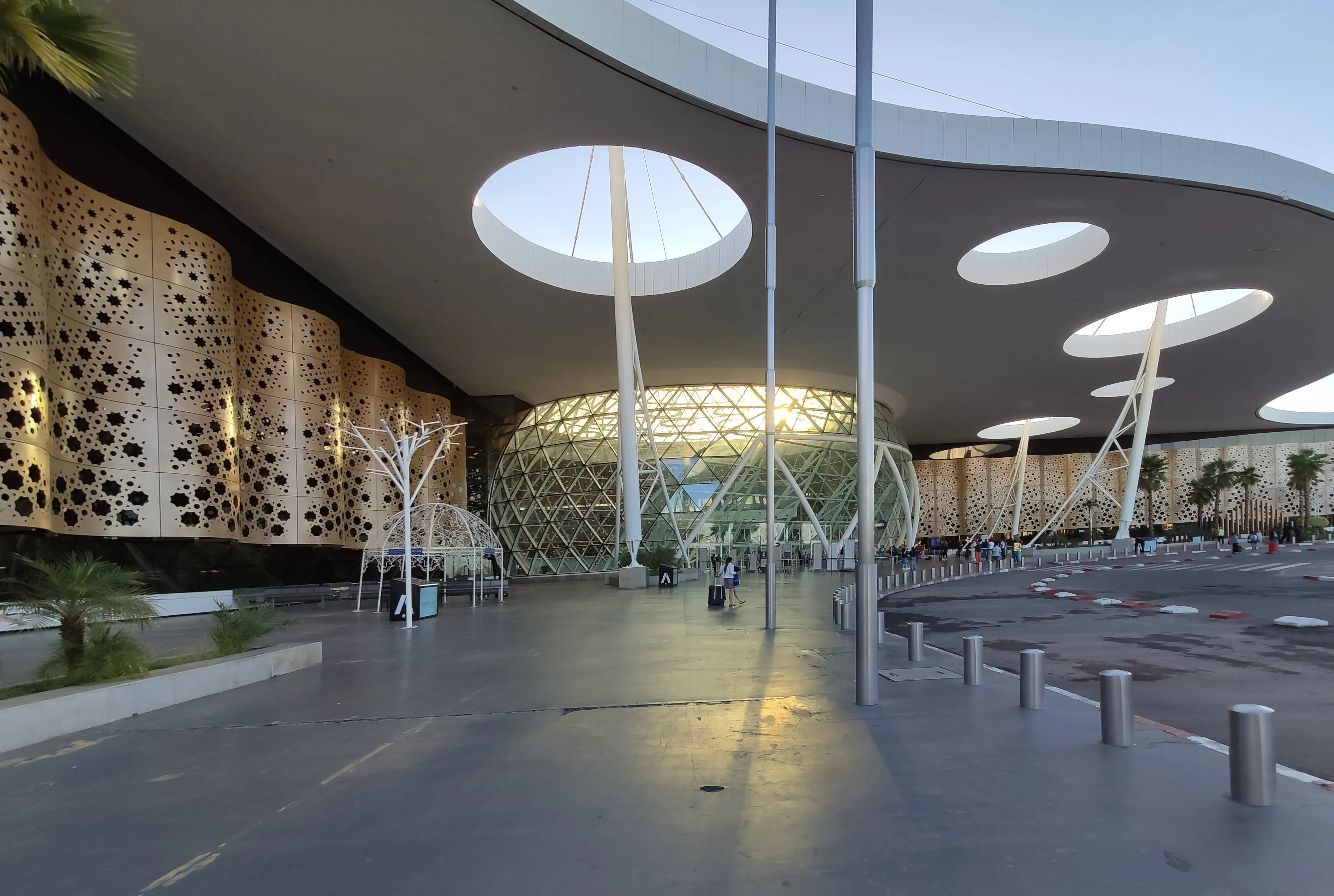
Where is Marrakech Menara Airport in relation to the city?
Marrakech Menara Airport (IATA code RAK, ICAO GMMX) is one of the closest major airports to its city centre anywhere in Morocco. It lies roughly 4 to 6 kilometres southwest of the historic core, which is why transfers are so short. As a rough mental map:
- Gueliz (the modern new town): about 4 km, ~10 minutes by car.
- Jemaa el-Fna and the medina (old town): about 5–6 km, ~15 minutes by car (longer in traffic).
- Marrakech train station (Gare de Marrakech, in Gueliz): about 4–5 km, ~10–15 minutes.
One crucial thing to understand before you land: no vehicle can drop you directly on Jemaa el-Fna square or deep inside the medina. The old town is a maze of narrow, largely pedestrian lanes (derbs), so taxis, buses and transfers stop at the edge of the medina — commonly near the Koutoubia mosque, Rue Arset El Bilk, or a car-accessible gate close to your riad. From there you finish on foot, sometimes with a porter for the bags. Factor in those last few hundred metres on foot when you plan your arrival, especially after dark.
The airport itself has two passenger terminals (T1 and T2) that are connected, and it handled well over 9 million passengers in 2025, so arrivals halls can be busy. For a full walkthrough of the buildings, ATMs, SIM cards and where exactly the transport pick-ups are, see our Marrakech airport terminals and facilities guide.
Quick comparison: bus, taxi, transfer or car?
Here is the at-a-glance comparison. All figures are indicative for 2026 and should be confirmed on site; taxi fares in particular vary by time of day and negotiation.
| Option | Time to centre | Indicative price | Pros | Cons |
|---|---|---|---|---|
| Bus 19 (ALSA shuttle) | 25–40 min | Cheapest; runs all day; Wi-Fi; luggage space | Stops at set points, not your riad door; limited hours; awkward with big bags | |
| Prepaid taxi (airport counter) | 15–20 min | ~100–150 MAD day (€9–€14); more at night | Fixed price up front; fast; card or cash; official | Pricier than the bus; some drivers still push extras |
| Private transfer (pre-booked) | 15–20 min | €15–€30 / 150–300 MAD per vehicle | Driver meets you with a sign; door-to-door; zero haggling | Costs more than a shared/metered taxi; must book ahead |
| Uber / ride-hailing | 15–20 min | ~120–220 MAD (€11–€20) | App price, no negotiation; available since 2025 | Pick-up point can be unclear; patchy availability at peak |
| Rental car (drive-in) | 15–25 min | From ~250 MAD/day + fuel | Total freedom for day trips | Chaotic city driving; nightmare medina parking; not for the centre |
Use this table to jump to your preferred choice below, where each option is explained in full.
Bus 19: the ALSA airport shuttle (cheapest option)
The No. 19 bus, run by the city operator ALSA, is the official airport ⇄ city shuttle and by far the cheapest way into town. It is ideal for budget travellers, solo visitors and anyone with light luggage who is not in a rush.
Route and stops
Bus 19 runs a loop between the airport and the city, calling at the places most travellers actually want:
- Marrakech Menara Airport (stop in the car park just outside arrivals)
- Jemaa el-Fna / medina edge (the main square area — your stop for medina riads)
- Gueliz (the modern centre, hotels, cafés, shops)
- Marrakech train station (Gare ONCF, for onward trains to Casablanca, Rabat, Fès, Tangier)
Because it is a loop, the exact order and the return routing can differ slightly, so check the on-board screen and ask the driver for the stop nearest your accommodation.
Price, tickets and luggage
- Price: around 30 MAD for a one-way ticket (~€3 / ~$3). A return ticket is often available for about 50 MAD. Buy from the driver or the ticket agent — have small change / cash ready, as large notes are rarely welcome.
- Frequency: roughly every 20–30 minutes, seven days a week.
- Operating hours: broadly early morning (around 6:00–6:15) until late evening (around 21:30–23:30) depending on the direction and season. These hours are indicative — the last departures shift, so confirm before travel and never count on Bus 19 for a very late arrival.
- Journey time: 25 to 40 minutes into the centre, depending on traffic and how many stops before yours.
- Comfort: the ALSA shuttle buses are modern, with air conditioning, comfortable seats, on-board Wi-Fi and dedicated luggage space — comfortable enough, but you still handle your own bags at each end.
Its limits: the bus drops you at fixed points, not at your riad door, so you still walk (or take a short petit taxi) the final stretch into the medina. It is less appealing after a long-haul flight with heavy suitcases or young children, and it does not run through the small hours. For official routing and timetables, ALSA publishes details on its own site (see external links below).
The prepaid taxi system (fixed fares since 2023)
Since 2023, Marrakech airport has run a prepaid taxi counter designed to end the old arrival-hall haggling. It is now the most transparent way to take a taxi straight to your door, and the process is simple:
- Go to the official taxi counter located near the arrivals exit (follow the taxi signage — ask staff if unsure).
- State your destination (your riad, hotel, Gueliz address or the train station).
- Pay the fixed fare shown for that destination, by card or in cash.
- Receive a receipt with the assigned taxi number.
- Go to the taxi rank, show your receipt, and the matching driver takes you in — no negotiation needed.
Indicative fixed fares
- Airport → medina / Jemaa el-Fna / Gueliz / train station: typically 100–150 MAD by day (about €9–€14). Some short hops to the nearest districts can be lower (~70–100 MAD), and busy periods or precise medina addresses can sit at the top of the range.
- Night surcharge: Moroccan taxis apply a night tariff of roughly +50% after dark, so late fares can climb toward 200 MAD.
- Petit taxi vs grand taxi: the petit taxi (small, beige-coloured, up to 3 passengers) is the standard city ride. A grand taxi (larger, for bigger groups or luggage, and for destinations outside the city) costs more.
If you would rather skip the counter and use a metered street taxi, the legal rule is to insist on the meter (“compteur, please”) as you get in, or fix the total price before departure and before loading luggage. Prices quoted informally range widely (roughly 70–200 MAD depending on time and bargaining), which is exactly why the prepaid counter exists.
Private transfers: the most comfortable arrival
A private transfer means a driver is booked in advance and waits for you at arrivals holding a sign with your name. It is the smoothest possible landing and is especially worth it if you arrive late at night, travel with family or lots of luggage, or if it is your first time in Morocco and you would rather not think about anything.
- Price: commonly €15–€30 (about 150–300 MAD) per vehicle — not per person. Many riads quote tiered rates, for example ~€15 by day, ~€20 in the evening and ~€30 late at night, for 2–3 people with bags.
- What you get: a driver watching the flight, help with suitcases, a fixed price paid in advance (zero haggling), and a drop-off as close to your riad as vehicles can reach.
- How to book: the easiest route is to ask your riad or hotel to arrange it when you reserve your room — they know exactly which medina gate is closest and can send a porter. Reputable transfer and activity platforms also sell fixed-price airport pick-ups.
The few extra euros over a taxi mainly buy peace of mind on landing, when you are tired and unfamiliar with the local codes. For airport transfers across Morocco more broadly — including intercity runs and other airports — you can also consult general resources such as moroccoairport.com, which cover the country’s airport transport options.
Uber and ride-hailing
Ride-hailing (Uber) has been available in Marrakech since 2025 and is another fixed-app-price option, typically 120–220 MAD (€11–€20) for the airport run, 15–20 minutes. The catch is the pick-up point: airport ride-hailing rules change, so the app may direct you to a specific meeting area, and availability can thin out at peak arrival times. Have a backup (the prepaid counter) in mind.
Renting a car and driving in
You can rent a car right at the airport — the arrivals area has the usual international and local desks, with rates from roughly 250 MAD per day plus fuel. But be honest about whether you need one:
- Good idea if you plan day trips or road journeys — the Atlas Mountains, Ourika Valley, Agafay desert, Essaouira on the coast, or a longer Morocco loop.
- Bad idea if you are staying in the medina. City-centre driving is chaotic, the old town is largely closed to cars, and parking near the medina is scarce and stressful. Most riads have no parking; you would leave the car in a paid lot on the edge and walk in anyway.
A common strategy is to arrive by taxi or transfer, enjoy the medina car-free, and only pick up a rental on the day you head out of town — some agencies will even deliver to your riad. For step-by-step arrival logistics (ATMs, SIMs, luggage, first-hour tips), see our Marrakech airport practical guide.
Walking or no transport?
Can you walk from RAK into town? Technically the medina is only ~5–6 km, but the honest answer is no for almost everyone: there is no pleasant pedestrian route, little shade, fast roads, and you would be hauling luggage. Skip walking as an arrival strategy. The one place walking matters is the final stretch: whatever transport you choose, expect to walk the last part into the pedestrian medina to reach your riad.
Getting to specific areas of Marrakech
Where you are staying should drive your choice. Here is how each key destination breaks down.
To Jemaa el-Fna and medina riads
The famous square is the heart of the old town and the reference point for most medina riads. Remember: no vehicle stops on the square itself. Taxis and transfers drop you at the nearest car-accessible point (often near the Koutoubia or Arset El Bilk), and you walk in — a porter can help with heavy bags.
- Best options: a pre-booked transfer (driver knows your exact derb) or the prepaid taxi. Bus 19 also serves the Jemaa el-Fna area for budget travellers.
- Time: ~15 minutes by car; 25–40 by bus.
For a dedicated breakdown of this exact route — taxi vs bus vs transfer, prices and scams — see our companion article on the blog, which digs into the airport-to-square journey in detail.
To Gueliz (new town)
Gueliz is the modern district — wide streets, hotels, cafés, boutiques — and it is car-friendly, so a taxi or transfer drops you right at your hotel door. It is also the closest main district to the airport (~4 km, ~10 minutes).
- Best options: prepaid taxi or Bus 19 (Gueliz is on the shuttle loop). Easy, cheap and quick either way.
To Marrakech train station
The Gare de Marrakech (ONCF) sits in Gueliz and is your gateway to trains for Casablanca, Rabat, Fès and Tangier. If you are connecting straight onto a train:
- Bus 19 stops at (or very near) the station — the budget connection.
- A prepaid taxi (~100–150 MAD) is faster and hands you off at the door with luggage — worth it if your train is soon.
To Agafay, Essaouira and day-trip transfers
For destinations outside the city — the Agafay desert, Essaouira (~2.5–3 hours to the coast), the Ourika Valley or the Atlas — you want a grand taxi or, better, a pre-arranged private transfer/tour. Fares are negotiated by distance and are far higher than a city hop; agree the total (and whether it is one-way or return with waiting time) before you set off. This is also where a rental car can pay off if you want to explore independently over several days.
Which option for which traveller?
- Solo backpacker / budget traveller, daytime arrival, light bag: Bus 19. Cheapest, simple, and you will not mind the short walk into the medina.
- Couple or friends, mid-range budget, want speed and no hassle: Prepaid taxi from the counter. Fixed price, 15 minutes, done.
- Family with kids, lots of luggage, or first trip to Morocco: Private transfer. Driver waiting, help with bags, straight to the riad, no decisions to make while tired.
- Late-night or very early arrival: Private transfer (best) or prepaid taxi. The bus may not be running.
- Planning road trips (Essaouira, Atlas, Agafay): Rental car, ideally picked up the day you leave the city rather than on arrival.
- App-first traveller who dislikes cash: Uber/ride-hailing or the prepaid taxi paid by card.
Money, tipping and payment
- Currency: the Moroccan dirham (MAD) is a closed currency — you generally get it in Morocco, not before. There are ATMs and exchange desks in the arrivals hall; withdraw or change a modest amount on landing.
- Carry small notes and coins. The bus, porters and many taxis expect cash and struggle with large notes. The prepaid taxi counter and Uber accept cards, but a few dirhams in your pocket smooths everything.
- Always talk in dirhams. A classic ploy is switching a quoted price from dirhams to euros on arrival — state and repeat the price in MAD.
- Tipping: modest and appreciated, not obligatory. A few dirhams (5–20 MAD) for a porter who carries bags into the medina; rounding up the fare for a taxi driver who was helpful. Transfers usually include the driver’s fee, but a small tip for luggage help is a kind gesture.
Safety: avoiding taxi touts and common tricks
Marrakech airport is generally safe, but the arrivals hall attracts touts — people offering “taxi, good price!” before you even leave the terminal. These middlemen mark the fare up. A few habits defuse almost every problem:
- Ignore anyone soliciting inside the hall. Walk to the official prepaid taxi counter or your pre-booked transfer driver (the one holding your name).
- Never load your bags before the price is agreed. Once suitcases are in the boot, your bargaining power vanishes. Price first, boot second.
- Insist on the meter or a fixed price in a street taxi, and say it in dirhams.
- Don’t believe “your riad is closed / moved.” A driver may claim this to divert you somewhere that pays commission. Insist on your booked address; call your riad if needed.
- Watch the “currency confusion” and surprise surcharges (“luggage,” “night,” “city entry”). With the prepaid receipt, the printed fare is the fare.
Accessibility and travelling with families
- Step-free arrival: the terminals are broadly step-free with lifts; request special assistance through your airline in advance if you need it.
- Buggies and car seats: standard taxis and buses do not carry child car seats — if you need one, arrange it with a private transfer company when you book.
- Strollers in the medina: the old town’s lanes are uneven and crowded; a transfer that gets you as close as possible to the riad saves a lot of stress with small children.
- Luggage help: transfers include a driver who lifts bags; porters are available at the medina edge for a few dirhams.
Night and early-morning arrivals
If you land late at night or before dawn, plan ahead:
- Bus 19 may not be running in the small hours — do not rely on it for a 2 a.m. arrival.
- The prepaid taxi counter is generally available for late flights, at the night tariff (~+50%).
- A pre-booked private transfer is the safest, calmest choice: the driver tracks your flight and waits, and you avoid navigating the dark medina alone with bags. Give your riad your flight number so someone can meet you at the gate if the lane is hard to find.
Common mistakes to avoid
- Relying on the bus for a late-night landing — check the last departure, or book a transfer.
- Not carrying small cash — the bus and porters want it; big notes cause friction.
- Loading luggage before agreeing the fare — the single most expensive mistake.
- Expecting a car to reach the square — it can’t; plan the final walk.
- Renting a car for a medina-only stay — you’ll pay for parking and stress you don’t need.
- Quoting prices in euros — always negotiate and pay in dirhams.
- Skipping the prepaid counter because a tout promised cheaper — it rarely is.
Final tips for a smooth transfer
Change or withdraw a little cash at the airport, have your riad’s exact address and phone number written down (including the derb name), and choose your mode before you land so you walk straight to the bus stop, the counter, or your driver. Arriving with a plan turns the Marrakech airport transfer from a potential hassle into a 15-minute non-event — leaving you free to enjoy the city.
Start planning the rest of your trip from our homepage, dig into arrival logistics in the Marrakech airport practical guide, and get to know the buildings in the terminals and facilities guide. For more on the airport itself, see the Wikipedia entry on Marrakesh Menara Airport and the operator ALSA’s Marrakech airport page for official bus information.
Frequently asked questions
How much is a taxi from Marrakech airport to the city centre?
Using the prepaid taxi counter (in place since 2023), expect a fixed fare of roughly 100–150 MAD (€9–€14) to the medina, Jemaa el-Fna, Gueliz or the train station by day, with a night surcharge of about +50% that can push late fares toward 200 MAD. You pay at the counter (card or cash), get a receipt with your taxi number, then walk to the rank — no haggling required. Figures are indicative; confirm on site.
How does Bus 19 work and how much does it cost?
Bus 19 is the ALSA airport shuttle. It costs about 30 MAD one-way (~€3), or roughly 50 MAD return, buy from the driver with small cash. It runs a loop between the airport, Jemaa el-Fna, Gueliz and the train station, every 20–30 minutes, from around 6 a.m. to late evening. The trip takes 25–40 minutes. Buses have air-con, luggage space and Wi-Fi, but stop at fixed points, not your riad door.
What’s the best option for a late-night arrival?
At night, Bus 19 may not be running, so the safest choices are a pre-booked private transfer (a driver waits with your name, fixed price) or the prepaid taxi counter at the night tariff. Give your riad your flight number so they can help you find the lane. Avoid touts who approach inside the terminal.
How far is Marrakech airport from Jemaa el-Fna?
Only about 5–6 km, roughly 15 minutes by car in normal traffic, or 25–40 minutes by Bus 19. Note that no vehicle stops on the square itself — you’re dropped at the medina edge (near the Koutoubia or Arset El Bilk) and walk the final stretch, with a porter if needed.
Is there Uber at Marrakech airport?
Ride-hailing (Uber) has been available in Marrakech since 2025, typically 120–220 MAD (€11–€20) for the airport run. It’s a fixed-app-price alternative to the taxi, but the pick-up point can be unclear and availability thins at peak times, so keep the prepaid counter as a backup.
Should I rent a car at the airport?
Only if you plan day trips or road journeys (Essaouira, Agafay, the Atlas). For a medina stay, skip it — city driving is chaotic, the old town is largely car-free, and parking is scarce. Rates start around 250 MAD/day. Many travellers arrive by taxi/transfer and only pick up a rental the day they leave the city.
How do I avoid taxi scams at Marrakech airport?
Three habits: use the official prepaid counter or a pre-booked driver, agree the price before your bags go in the boot, and always deal in dirhams (never switch to euros). Ignore anyone offering a taxi inside the terminal, insist on the meter or a fixed price in street taxis, and keep your prepaid receipt as proof of the fare.
Can I get from the airport straight to the train station?
Yes. Bus 19 stops at or near the Gare de Marrakech (ONCF) in Gueliz for about 30 MAD, or a prepaid taxi (~100–150 MAD) takes you door-to-door in ~10–15 minutes — the better choice if your onward train to Casablanca, Rabat or Fès is soon.