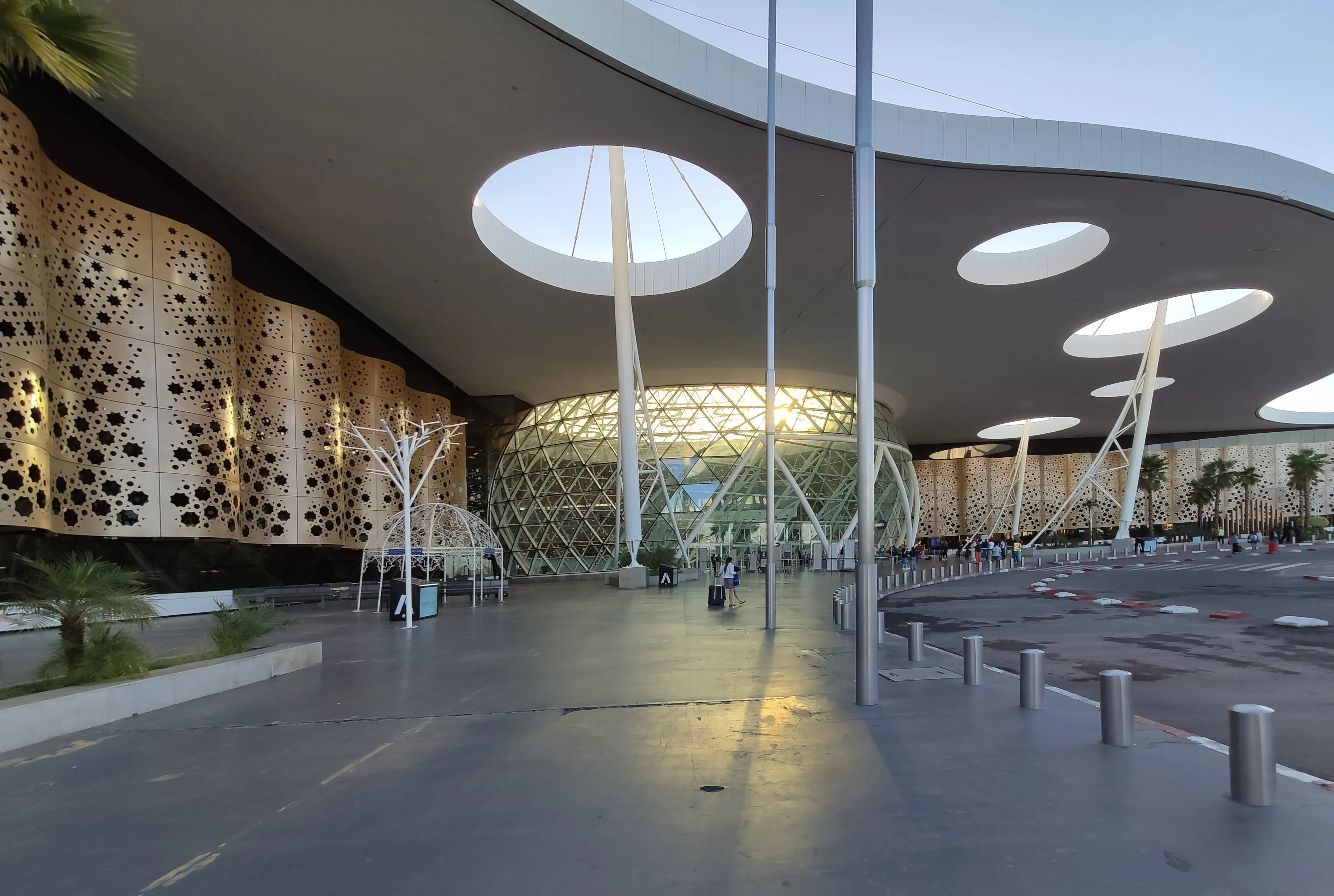
Let’s start with the most important thing, because it is easy to lose sight of it after reading a list of traps: Marrakech Menara Airport (RAK) is a normal, generally safe international airport, and the overwhelming majority of arrivals pass through it without any problem at all. The “scams” you may have read about are not violent crime and they are not organised gangs. They are, almost without exception, pushy commercial hustles — someone trying to get more of your money than a service is worth, usually in the first confusing hour after a long flight when you are tired, jet-lagged and unsure of the local prices.
That last point is the key to everything. Nearly every airport scam works only because the traveller does not yet know two or three simple facts: what a taxi should cost, where the official rank is, and how Moroccan dirhams look and feel. Once you know those facts, the hustles collapse. A tout has nothing to sell you if you already know the price. This guide gives you exactly those facts, scam by scam, so that you can walk through the arrivals hall calm, friendly and completely in control.
We have written this to be reassuring, not frightening. Read it once before you fly, keep the summary table on your phone, and you will arrive in Marrakech relaxed and ready to enjoy one of the most extraordinary cities on earth.
Quick answer: what actually happens at RAK
The typical arrival experience at Marrakech Airport is smooth. You clear passport control, collect your bag, walk out into the arrivals hall, and either meet your pre-booked driver, take an official taxi from the rank, or ride the airport bus into town. Thousands of people do this every day without incident.
The problems, when they happen, cluster in a predictable set of moments: at the exit doors where drivers wait, at the currency-exchange desks, at the SIM-card counters, and occasionally with someone claiming your accommodation has a problem. Every one of these is avoidable with information you can absorb in ten minutes. Below is the at-a-glance version, followed by a detailed walkthrough of each scam.
The scams at a glance
| Scam | How it works | How to avoid it |
|---|---|---|
| Unofficial taxi tout | A friendly “helper” approaches you inside the terminal offering a taxi, then charges 2–4x the normal fare | Ignore anyone who approaches you; walk to the official taxi rank outside and use metered or fixed-rate taxis only |
| Taxi overcharging | Driver quotes a high flat price, or claims the meter is “broken”, then inflates the total | Agree the price before getting in; know the fixed airport tariff; insist on the meter for petit taxis |
| “Your riad is closed / moved” | Driver claims your accommodation is shut, full or relocated, then takes you to a place that pays him commission | Call your riad directly; refuse any change of destination; insist on being taken exactly where you booked |
| Fake porters | Someone grabs your bag “to help”, then demands a large tip | Keep hold of your own luggage; a polite firm “no thank you” is enough |
| Currency / change tricks | Poor exchange rates, missing notes, or “no change” so you overpay | Change a small amount only, count notes before leaving the desk, carry small denominations |
| SIM-card overcharge | Airport kiosk sells a tourist SIM at several times the normal price | Buy from an official operator counter, or wait and buy in the city; know the real prices |
| Fake officials | Someone in vague “uniform” asks to see documents or collect a “fee” | Real officials are at fixed posts; never pay a cash “fee”; ask for ID and go to an official desk |
| Confusion / rushing | You are hurried into a decision before you can think or compare | Slow down; step aside; nothing at an airport requires an instant decision |
Unofficial taxi touts
This is the single most common hustle at Marrakech Airport, and understanding it defuses most of your risk in one go.
Here is how it plays out. As you walk out of baggage reclaim into the arrivals hall — sometimes even before, near the exit — a smiling, well-dressed man approaches you. He is friendly, speaks good English or French, and asks, “Taxi? Where are you going? I help you.” He may say the official rank is “closed”, “very far”, or “full”, or that “no taxis right now”. He walks with you, chats, offers to carry your bag, and steers you towards his car in a nearby car park. Only later, at your destination, does the price turn out to be two, three or four times what the ride should cost — and by then you are in an unfamiliar city with your luggage, and arguing feels impossible.
The important thing to understand is that legitimate taxi drivers in Marrakech do not need to approach you inside the terminal. They wait at the official rank outside. Anyone who walks up to you inside the building and offers a taxi is, by definition, working outside the official system. That single rule — ignore anyone who approaches me — protects you from the entire scam.
How to avoid it: Keep walking. A polite “no thank you”, without stopping or making eye contact for too long, is all you need; you owe no one an explanation. Head straight for the exit and the official taxi rank outside the terminal, where cars queue in order. If you want zero friction, pre-book a private transfer before you fly and meet your driver holding a name sign — that removes the entire decision from the arrivals hall. For the full breakdown of your options, routes and realistic costs, see our guide on getting from Marrakech Airport to the city centre.
Taxi overcharging (and the “broken meter”)
Once you are at the rank with a legitimate taxi, the second hustle can appear: the price itself.
Marrakech has two kinds of taxi. Grands taxis are larger (often cream or beige) cars that carry more passengers and typically use a fixed price for the airport run. Petits taxis are small city cabs (in Marrakech they are traditionally a sandy/ochre colour) that are supposed to run on a meter for trips within the city. Both are perfectly legitimate. The overcharging happens in two ways: a grand-taxi driver quotes an inflated flat fare hoping you don’t know the standard rate, or a petit-taxi driver says the meter is “broken” or “not working” and then names a high number at the end.
There is an official fixed tariff for taxis between the airport and the city, and it is usually higher at night (roughly after 8 pm) than during the day — that night surcharge is legitimate and not a scam in itself. The scam is being charged well above the posted rate, or being told a metered ride must be a flat price several times the norm.
How to avoid it:
- Agree the price before you get in, every time. For a grand taxi, confirm the flat fare out loud before your bag goes in the boot. For a petit taxi, ask for the meter — “compteur, s’il vous plaît” — and if the driver refuses or claims it’s broken, either agree a fair flat price first or simply use the next car in the rank.
- Know the going rate before you arrive so a quote either matches reality or obviously doesn’t. Our regularly updated breakdown of realistic day and night fares is here: Marrakech Airport taxi prices.
- Have small notes ready. Handing over a 200-dirham note for a short fare invites the “I have no change” version of the trick (see currency section below). Break large notes before you need a taxi.
- Stay friendly but firm. This is a negotiation, not a confrontation. A calm “no, that’s too much, the normal price is X” resolves the vast majority of cases instantly.
The “your riad is closed / moved” scam
This one is less common but worth knowing because it targets your trust rather than your ignorance of prices, and it plays on a genuine feature of Marrakech: many visitors stay in a riad, a traditional house tucked deep inside the medina where cars cannot go, and the exact door can be hard to find.
The scam works like this. During the ride, the driver — or a “helpful” middleman who intercepted you — casually mentions that he knows your riad, and that it has “closed down”, “changed owners”, “is full tonight”, or “moved to a new location”. He seems concerned for you. Conveniently, he knows “a better place, same price, my cousin’s”. If you agree, he takes you somewhere that pays him a commission, often at a worse rate and away from where you actually booked. In a subtler version, he simply drops you at the wrong spot in the medina and hands you to a “guide” who then demands money to lead you to your real riad.
How to avoid it:
- Assume it is untrue. In almost every case the riad is open and expecting you. A driver has no reliable way of knowing that your specific accommodation closed today.
- Call your riad directly. Every reputable riad gives you a phone number and expects arrival calls. Phone them the moment there is any doubt and let them speak to the driver if needed — many will happily send someone to meet you at a known landmark (like a square or gate) where cars can stop.
- Refuse any change of destination. Repeat the name and address of where you booked, and insist on being taken there and nowhere else. You are not obliged to accept an “alternative”.
- Have your booking confirmation on your phone with the address and phone number visible, so you can show it and call in seconds.
Fake porters
At the exit, and sometimes at the luggage belt, someone may take hold of your suitcase “to help” before you have agreed to anything. He wheels it a short distance to the taxi or the door and then expects a substantial tip — far more than the tiny service warrants — and can become insistent if you hesitate.
There is nothing dangerous here, and genuine, honest help does exist. The issue is the unrequested “help” that becomes a demand.
How to avoid it: keep a hand on your own bag and a polite “no thank you, I’ve got it” ready. If you did want help and someone gave it, a small tip of a few dirhams is courteous — but you set the amount, and you are never obliged to accept help you didn’t ask for. Keep your valuables, passport and phone on your person, not in a bag someone else is holding.
Currency and change tricks
Money is where tired travellers lose the most, and the tricks are simple.
Poor exchange rates. Airport currency-exchange desks almost always offer worse rates than banks or exchange offices in the city, and the very first desk you see may be the least competitive. Some display an attractive “buy” rate in large numbers while the rate that actually applies to you (the “sell” side) is much worse, or bury a hefty commission in the fine print.
The “no change” squeeze. Whether at an exchange desk, a taxi or a kiosk, you hand over a large note and are told there is no change, nudging you to overpay or to accept a worse deal rather than argue.
Short-changing and note confusion. Moroccan dirham notes (20, 50, 100, 200) can look unfamiliar at a glance when you are jet-lagged, which makes it easy to be handed too little and not notice, or to mistake one note for another.
How to avoid it:
- Change only a small amount at the airport — just enough for a taxi and the first day — and get a better rate at a bank or bureau de change in the city, or simply withdraw dirhams from a bank ATM. Note that the dirham is a closed currency: you generally can’t buy much of it abroad, so a small airport exchange or an ATM withdrawal on arrival is normal.
- Count your money before you step away from any desk or driver, every single time. Once you have walked off, it is too late.
- Prefer ATMs attached to recognised banks and be wary of machines offering “conversion” into your home currency at the screen (dynamic currency conversion) — decline it and choose to be charged in dirhams for a better rate.
- Carry small denominations. Break big notes at a bank or a supermarket, and keep 20s and 50s handy so no one can play the “no change” card on you.
- Learn the notes on the plane. Two minutes looking at pictures of the 20, 50, 100 and 200 dirham notes makes short-changing almost impossible.
SIM-card overcharging
Getting a local SIM is a great idea — data lets you use maps, call your riad and book rides — but the kiosks nearest the arrivals exit sometimes sell “tourist” packages at several times the normal price, or load you up with far more data than a short trip needs.
Morocco has three main mobile operators, and a normal prepaid tourist SIM with a generous data allowance is inexpensive by international standards. If a package costs many times that, you are paying the airport-convenience premium — or an outright markup.
How to avoid it:
- Buy from an official operator counter rather than a generic kiosk, and check the price and data allowance before you pay.
- Know the ballpark real price so a quote is obviously fair or obviously not. If it feels expensive, it probably is.
- You can always wait. Official operator shops are all over the city and often cheaper, and free Wi-Fi at the airport and your riad covers you in the meantime. There is no need to decide in the first five minutes.
- Bring your passport — registering a SIM to your ID is a legal requirement, not a scam.
Fake officials
This is uncommon, but travellers ask about it, so here is the reassurance. Occasionally someone in a vague semi-uniform, or simply an official-sounding manner, may approach and ask to “check” your documents, your currency, or collect some “fee” or “tax” in cash.
Genuine airport and immigration staff work at fixed, clearly marked posts — passport control booths, customs desks, official information counters. They do not roam the arrivals hall collecting cash fees from individuals, and there is no legitimate cash “fee” to be paid to a person who walks up to you.
How to avoid it: never hand cash to anyone claiming to be an official in the open hall. If someone asks, stay calm, decline politely, and if they persist, walk to a staffed official desk or a uniformed police/gendarmerie officer and repeat what happened. The request evaporates the moment you head towards real authority. Keep your passport in your own control and don’t surrender it to anyone who isn’t clearly at an official post.
General safety tips for arriving at RAK
Beyond the specific scams, a handful of habits make your arrival effortless:
- Slow down. The single trait every hustle relies on is a rushed, disoriented traveller. Step to one side, breathe, sort out your bag and phone, and decide calmly. Nothing at an airport requires a snap decision.
- Decide your transport before you land. Pre-book a transfer, or resolve to use the official rank or the airport bus, so you are not making the choice under pressure. Our airport-to-city guide lays out every option.
- Keep documents and valuables on your body, ideally in a zipped inner pocket or a money belt — passport, cards, phone, and a small amount of cash separate from the rest.
- Split your cash. Keep a little in an easy pocket for the taxi and the rest tucked away, so you never flash a thick wad.
- Have your riad’s name, address and phone number saved offline and your booking confirmation ready to show.
- Stay polite and smile. Marrakchis are warm and hospitable, and the vast majority of people offering help genuinely mean it. Firmness and friendliness are not opposites — you can decline warmly.
- Trust your gut. If something feels off, it’s fine to disengage, walk to an official desk, or simply wait. You are never trapped.
- Learn two words. “La, shukran” (no, thank you) in Moroccan Arabic, or “non merci” in French, said with a smile, closes almost any unwanted approach.
What to do if you think you’ve been scammed
First, keep it in perspective: airport hustles cost money and dignity, not safety. If you realise you have overpaid or been misled, here is how to handle it calmly.
- In the moment, if you haven’t yet paid or left, stop the transaction. Recount the money, restate the agreed price, and don’t be hurried. If a taxi total doesn’t match what you agreed, pay the agreed amount and step out; you are not obliged to accept a number invented at the destination.
- If you’ve already paid, decide whether it’s worth pursuing. A few dirhams overpaid is rarely worth a long dispute; a serious overcharge may be.
- Note the details. For a taxi, the licence plate and, if possible, a photo of the vehicle and any posted taxi number help enormously if you want to report it.
- Report it to the tourist police (Brigade Touristique), a police officer, or the airport information desk. Morocco takes tourism seriously and maintains a dedicated tourist police precisely to handle these situations.
- Contact your bank immediately if a card was misused, an ATM behaved oddly, or you suspect card skimming, and freeze the card from your banking app.
- Tell your accommodation. Riad hosts know the local landscape, can advise you, and can often help you recover a situation or point you to the right official channel.
The goal is not to spend your holiday filing complaints — it’s to know that you have simple, real recourse, which is exactly why these hustles rarely escalate.
Official channels and further help
For authoritative, up-to-date information, go to primary sources rather than rumour. Two useful starting points:
- Your own government’s travel advice for Morocco, such as the UK Foreign, Commonwealth & Development Office travel advice, which covers safety, scams, local laws and emergency contacts and is refreshed regularly.
- The Moroccan National Tourism Office, for official visitor information and services.
At the airport itself, the official information desk, uniformed police and gendarmerie, and the tourist police are all there to help, and airport staff can point you to the official taxi rank and the bus. When in doubt, an official desk is always the right place to go.
If you’d like to plan the practical side of your arrival in detail — routes, times, realistic costs and the airport bus — start with our two companion guides on getting from the airport to the city centre and taxi prices, and browse the rest of our Marrakech airport resources on the homepage.
Frequently asked questions
Is Marrakech Airport safe?
Yes. Marrakech Menara Airport is a normal international airport and is generally safe. The issues travellers encounter are commercial hustles — overcharging and pushy touts — rather than violent crime. Knowing the common tricks and the real taxi prices in advance removes almost all of the risk, and the vast majority of arrivals have no problem at all.
How much should a taxi from Marrakech Airport cost?
There is an official fixed tariff for the airport-to-city run, and it is normally higher at night than during the day. The exact figure changes over time, so check our regularly updated Marrakech Airport taxi prices page before you travel, agree the price before you get in, and be aware that a legitimate night surcharge is not a scam.
Should I pre-book an airport transfer?
Pre-booking a private transfer is the lowest-stress option, especially for a late arrival, a family, or a first visit. You meet a named driver, the price is fixed in advance, and you skip the arrivals-hall negotiation entirely. Official taxis from the rank and the airport bus are perfectly good alternatives if you prefer to sort it out on arrival — see our airport-to-city guide.
Someone inside the terminal offered me a taxi — should I take it?
No. Legitimate taxi drivers wait at the official rank outside; they don’t need to approach you inside the building. Anyone who walks up to you in the arrivals hall offering a taxi is operating outside the official system and is likely to overcharge. Decline politely and walk to the official rank or your pre-booked driver.
Where should I change money at the airport?
Change only a small amount at the airport — enough for a taxi and your first day — because airport exchange rates are usually poor, then use a bank, a city bureau de change, or a bank ATM for the rest. Always count your money before leaving the counter, decline any on-screen “conversion” at ATMs, and carry small notes so no one can use the “no change” trick.
Is buying a SIM card at the airport a scam?
Not inherently, but airport kiosks often charge several times the normal price or oversell your data. Buy from an official operator counter, check the price and allowance first, and bring your passport (registration is a legal requirement). If it feels expensive, wait and buy from an operator shop in the city, where it’s usually cheaper.
What is the “your riad is closed” trick?
It’s when a driver or middleman claims your accommodation has closed, moved or is full, then steers you to a place that pays him a commission. Assume it’s untrue, call your riad directly to confirm, refuse any change of destination, and insist on being taken exactly where you booked. Keep your booking confirmation and the riad’s phone number ready on your phone.
What should I do if I’ve been overcharged?
Stay calm and keep it in proportion. If you haven’t paid yet, restate the agreed price and don’t be rushed. If you have, note the taxi’s licence plate or the desk involved, and report it to the tourist police, a police officer, or the airport information desk. Contact your bank if a card was involved, and tell your accommodation, who can often help. Recourse exists, which is exactly why these hustles rarely go far.